
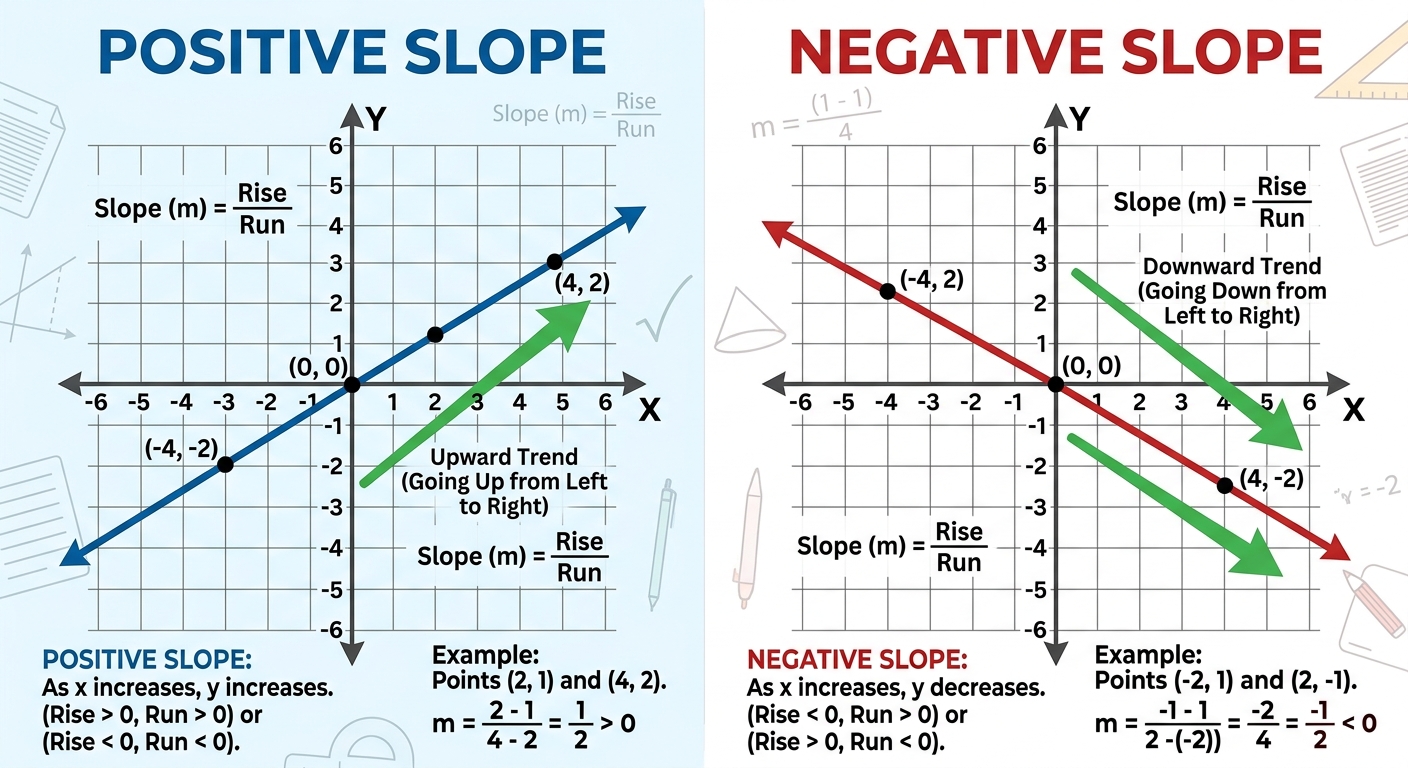
Positive And Negative Slope: How To Tell Them Apart
The short version
- A positive slope goes up as you read the graph left to right. A negative slope goes down left to right.
- Slope = rise ÷ run = (y2 – y1) ÷ (x2 – x1). If the answer is above zero, the slope is positive. If it’s below zero, it’s negative.
- A horizontal line has a slope of 0. A vertical line has an undefined slope, because the run is 0 and you can’t divide by 0.
- The sign tells you direction. The size tells you steepness: a slope of -5 is steeper than a slope of 2.
The difference between positive and negative slope is direction. Read a line from left to right the way you read a sentence: if it climbs, the slope is positive; if it falls, the slope is negative. In numbers, a positive slope means y increases when x increases, and a negative slope means y decreases when x increases.
So y = 2x + 1 has a positive slope (the 2), and y = -3x + 7 has a negative slope (the -3). Below we cover how to find the sign from two points, an equation, a table or a graph, what zero and undefined slopes mean, and the mistakes that flip the sign by accident.
What slope measures
Slope is how much a line goes up or down for every one step it moves to the right. It’s written as m, and it’s a ratio:
m = rise ÷ run = (y2 – y1) ÷ (x2 – x1)
Rise is the vertical change. Run is the horizontal change. A slope of 3 means the line goes up 3 for every 1 step right. A slope of -1/2 means it goes down 1 for every 2 steps right.
Positive and negative slope side by side
| Positive slope | Negative slope | Zero slope | Undefined slope | |
|---|---|---|---|---|
| Left to right, the line | Goes up | Goes down | Stays flat | Goes straight up and down |
| As x increases, y | Increases | Decreases | Stays the same | x never changes |
| Rise and run | Same sign | Opposite signs | Rise is 0 | Run is 0 |
| Example equation | y = 2x + 1 | y = -3x + 7 | y = 4 | x = 3 |
| Real-life example | Savings growing each week | Water draining from a tank | A parked car’s distance from home | The edge of a wall |
When the slope is positive
A slope is positive when the rise and run have the same sign. As you move right, the line moves up. Anything that grows at a steady rate has a positive slope: the total cost of apples at $2 a pound, distance traveled at a constant speed, money in a jar when you add $5 every week.
Worked example: two points
Find the slope through (1, 2) and (4, 8).
Rise: 8 – 2 = 6
Run: 4 – 1 = 3
m = 6 ÷ 3 = 2
The slope is positive. For every 1 step right, the line goes up 2.
When the slope is negative
A slope is negative when the rise and run have opposite signs. Moving right, the line goes down. Anything that shrinks at a steady rate has a negative slope. A 50 gallon tank draining at 4 gallons a minute follows y = -4x + 50, where x is minutes and y is gallons left. The slope, -4, means the tank loses 4 gallons every minute.
Worked example: two points with negatives
Find the slope through (-2, 5) and (3, -5).
Rise: -5 – 5 = -10
Run: 3 – (-2) = 3 + 2 = 5
m = -10 ÷ 5 = -2
The slope is negative. For every 1 step right, the line drops 2.
You can subtract in the other order as long as you keep both the same: (5 – (-5)) ÷ (-2 – 3) = 10 ÷ -5 = -2. Same answer.
Zero and undefined slope
These two are the edge cases next to positive and negative slope, and they get mixed up constantly.
Zero slope: horizontal lines
Through (1, 4) and (6, 4):
Rise: 4 – 4 = 0
Run: 6 – 1 = 5
m = 0 ÷ 5 = 0
The line is flat. Its equation is y = 4. Zero divided by anything (except 0) is 0.
Undefined slope: vertical lines
Through (3, 1) and (3, 7):
Rise: 7 – 1 = 6
Run: 3 – 3 = 0
m = 6 ÷ 0, which can’t be done
The slope is undefined. The line is vertical, and its equation is x = 3.
A memory trick: a flat floor has zero slope because you can walk on it. A wall has undefined slope because you can’t.
How to tell the sign of a slope without a graph
From an equation
Get it into y = mx + b form and look at m.
y = -3x + 7: m = -3, negative.
2x + 5y = 10: subtract 2x to get 5y = -2x + 10, then divide by 5 to get y = -(2/5)x + 2. The slope is -2/5, negative.
A shortcut for the form Ax + By = C: when A and B have the same sign, the slope is negative. When they have opposite signs, it’s positive. In 2x + 5y = 10, both are positive, so the slope is negative.
From a table
| x | 0 | 1 | 2 | 3 |
|---|---|---|---|---|
| y | 10 | 7 | 4 | 1 |
As x goes up by 1, y goes down by 3 each time. The slope is -3, negative.
Steepness is the size, not the sign
Ignore the sign and compare the numbers. y = -5x is steeper than y = 2x because 5 is bigger than 2. A slope of 0.5 is gentle. A slope of -8 is a cliff going down.
Common mistakes with slope
- Mixing the order of subtraction. Doing y2 – y1 on top but x1 – x2 on the bottom flips the sign. Pick one point to go first and keep it first in both.
- Putting x on top. It’s rise over run, y over x. Run over rise gives the wrong number.
- Losing a negative sign. 3 – (-2) is 5, not 1. Most wrong slopes with negative coordinates come from this.
- Reading the graph right to left. A line that falls left to right looks like it’s climbing if you read it backward.
- Swapping zero and undefined. Horizontal is 0. Vertical is undefined. “No slope” is ambiguous, so avoid it.
- Taking the slope from the wrong form. In 2x + 5y = 10, the slope isn’t 2. Solve for y first.
Practice problems
- Is the slope of y = -x + 4 positive, negative, zero or undefined?
- Find the slope through (2, 3) and (6, 11).
- Find the slope through (0, 6) and (3, 0).
- Find the slope through (-4, 2) and (5, 2).
- Find the slope through (7, -1) and (7, 9).
- Find the slope of 3x – 4y = 12 and say whether it’s positive or negative.
- A table shows x values 1, 3, 5 and y values 9, 5, 1. What is the slope?
- Which line is steeper: y = -4x + 1 or y = 3x – 2?
Answers
- Negative. The slope is -1.
- (11 – 3) ÷ (6 – 2) = 8 ÷ 4 = 2. Positive.
- (0 – 6) ÷ (3 – 0) = -6 ÷ 3 = -2. Negative.
- (2 – 2) ÷ (5 – (-4)) = 0 ÷ 9 = 0. Zero slope.
- (9 – (-1)) ÷ (7 – 7) = 10 ÷ 0. Undefined.
- -4y = -3x + 12, so y = (3/4)x – 3. The slope is 3/4, positive.
- y drops 4 every time x goes up 2, so the slope is -4 ÷ 2 = -2.
- y = -4x + 1, because 4 is bigger than 3. The sign only tells you it goes down.
What it means if your kid is stuck on slope
Positive and negative slope looks like a new idea, but most mistakes come from older skills. Integer subtraction is the big one: a kid who isn’t sure what 3 – (-2) equals will get the sign of the slope wrong about half the time, and it’ll look like they don’t understand slope. Fractions and division are next, since slopes like -2/5 need both. Then there’s solving for y, which is two-step equation work.
Try giving your child a few integer problems on their own, like -5 – 5 and 3 – (-2). If those are shaky, that’s the thing to fix. The fraction side of this story usually starts years before algebra class, as we lay out in struggling with algebra? The real problem is usually fourth grade fractions. If a graph on the homework sheet sets off panic before any work happens, our guide to math anxiety in children is worth a read too.
Frequently asked questions
How do you know if a slope is positive or negative?
Read the line from left to right. Up means positive, down means negative. With numbers, compute rise ÷ run: a result above zero is positive, below zero is negative.
What does a negative slope mean in real life?
Something is decreasing at a steady rate. A phone battery dropping 10% an hour, a car’s value dropping each year, or a tank draining at 4 gallons a minute all have negative slopes.
Is a slope of 0 positive or negative?
Neither. A slope of 0 is a horizontal line, where y never changes.
Is undefined slope the same as zero slope?
No. Zero slope is a horizontal line (rise is 0). Undefined slope is a vertical line (run is 0, and division by 0 isn’t possible).
Can a slope be a fraction or a decimal?
Yes. A slope of 3/4 means up 3 for every 4 to the right. A slope of -0.5 means down 1 for every 2 to the right.
Find the actual gap
When slope keeps coming out with the wrong sign, the fix is rarely more slope practice. It’s usually integers, fractions or equation solving. Math Anon’s short adaptive assessment checks those skills and hands you a written report that names which ones are missing.
From there, your child does about 20 minutes a day of practice targeted at those skills, with a progress report sent to you weekly. The assessment is $49 and gets credited back in full on your first month. You can start the assessment or read about pricing first.





