
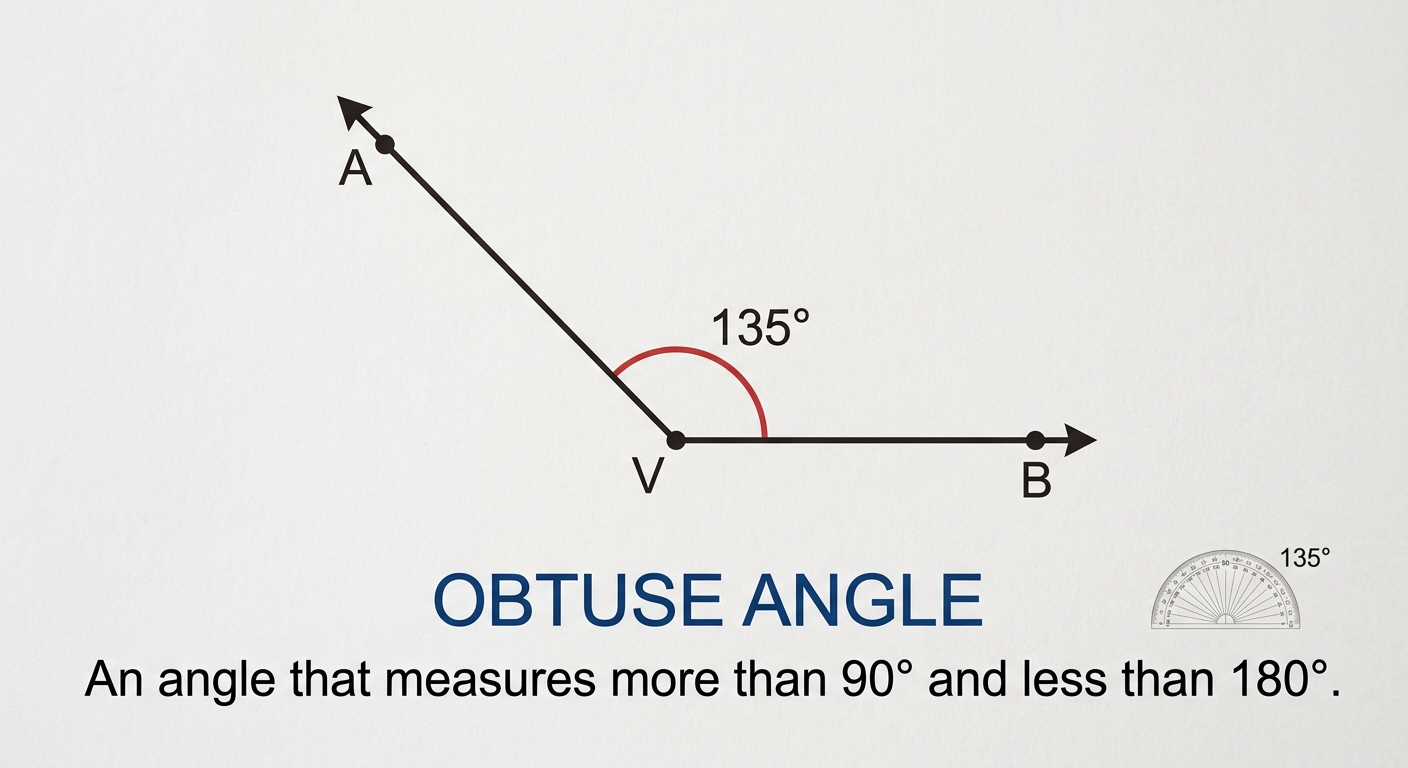
What Is An Obtuse Angle? Definition, Examples And Practice
The short version
- An obtuse angle is any angle greater than 90° and less than 180°. It’s wider than the corner of a piece of paper but not flat.
- Exactly 90° is a right angle and exactly 180° is a straight angle. Neither one is obtuse.
- When you measure an obtuse angle with a protractor, the reading has to be over 90. If you get 60 and 120 on the two scales, it’s 120.
- A triangle can have at most one obtuse angle. Two would already add to more than 180°.
An obtuse angle is an angle that measures more than 90° but less than 180°. Picture a right angle, like the corner of a book, then open it wider without letting it go flat. Angles of 91°, 120° and 179° are all obtuse.
That’s the obtuse angle definition in one line. Below, we’ll show how to tell obtuse angles from the other types, how to measure one without misreading the protractor, what makes a triangle obtuse, and where kids usually slip. There’s a practice set with an answer key near the end.
Obtuse angles compared with other angle types
Angles get named by size. Here’s the full lineup, smallest to largest:
| Type | Size | Looks like |
|---|---|---|
| Acute | More than 0° and less than 90° | Narrower than a square corner |
| Right | Exactly 90° | A square corner |
| Obtuse | More than 90° and less than 180° | Wider than a corner, not flat |
| Straight | Exactly 180° | A straight line |
| Reflex | More than 180° and less than 360° | Bent back past straight |
| Full turn | Exactly 360° | All the way around |
The word helps too. “Obtuse” comes from a Latin word meaning blunt or dull. An acute angle is sharp and pointy. An obtuse angle is blunt and open.
How to tell if an angle is obtuse
The quickest way to identify an obtuse angle is to hold it up against a right angle. Any square corner works: a sheet of paper, an index card, a book.
- Line up one edge of the paper with one side of the angle, with the corner at the vertex.
- Look at the other side of the angle.
- If it falls outside the paper, the angle is wider than 90°. As long as the two sides don’t form a straight line, the angle is obtuse.
- If it lines up exactly with the paper’s other edge, it’s a right angle. If it falls inside the paper, it’s acute.
Clocks are good practice too. Each hour mark is 30° apart, since 360 ÷ 12 = 30. At 4:00 the hands are 4 hours apart, so the angle is 4 × 30 = 120°, which is obtuse. At 5:00 it’s 150°, also obtuse. At 3:00 it’s exactly 90°, a right angle.
How to measure an obtuse angle with a protractor
This is where most mistakes happen, because a protractor has two rows of numbers.
- Decide first. Look at the angle. Is it wider than a corner? Then your answer must be between 90 and 180.
- Place the center point of the protractor exactly on the vertex.
- Line up the baseline (the 0° line) with one side of the angle.
- Find the 0 on the side where your baseline arm sits, and read up from that 0 on the same scale.
- Read where the other side crosses. The two scales always add to 180, like 60 and 120. Use step 1 to pick the right one.
Example: the second side of the angle crosses the protractor where the scales read 55 and 125. The angle is obviously wider than a corner. So it’s 125°. Writing 55° here is the single most common error in this whole topic, and step 1 prevents it.
If the sides are too short to reach the numbers, extend them with a ruler first. The size of an angle doesn’t depend on how long its sides are drawn.
Obtuse triangles
An obtuse triangle is a triangle with one obtuse angle. The angles of any triangle add to 180°, which leads to two facts:
- A triangle can’t have two obtuse angles. Two angles over 90° would add to more than 180° before you even get to the third.
- The other two angles are acute and add to less than 90°.
Worked example: a triangle has angles of 110° and 30°. Find the third angle.
110 + 30 = 140
180 – 140 = 40
The third angle is 40°, and this is an obtuse triangle because of the 110° angle.
Check whether angles are possible: could a triangle have angles of 100° and 85°? 100 + 85 = 185, which is already more than 180. No.
Obtuse angles in other shapes
Many shapes are full of obtuse angles. Each interior angle of a regular pentagon is 108°. Each interior angle of a regular hexagon, like a honeycomb cell, is 120°. A rectangle has none, because all four of its angles are right angles.
Obtuse angles and supplementary angles
If an obtuse angle sits on a straight line next to another angle, the two add to 180°. That makes them supplementary. The partner of an obtuse angle in a supplementary pair is always acute: 180 – 130 = 50. We cover this in Supplementary Angles, Explained.
One more connection: every obtuse angle has a reflex angle on its other side. The two together make a full turn. If the inside is 130°, the outside is 360 – 130 = 230°.
Common mistakes with obtuse angles
- Reading the wrong protractor scale. Reporting 55° for an angle that’s clearly wide. Always estimate first.
- Calling 90° or 180° obtuse. Obtuse means strictly between them. 90° is right and 180° is straight.
- Judging by side length. Kids think an angle with long arms is bigger. Only the opening between the arms matters.
- Judging by position. An obtuse angle turned on its side or upside down is still obtuse. Kids used to seeing angles with a flat bottom edge sometimes miss this.
- Two obtuse angles in a triangle. If a kid’s answer gives a triangle two angles over 90°, something went wrong earlier.
Practice problems
- Is a 95° angle acute, right or obtuse?
- Is a 180° angle obtuse?
- Which of these are obtuse: 45°, 91°, 150°, 179°, 200°?
- A protractor shows 70 and 110 where the second side crosses. The angle is wider than a square corner. What’s its measure?
- What’s the angle between the clock hands at 5:00? Is it obtuse?
- A triangle has angles of 115° and 25°. Find the third angle.
- Can a triangle have angles of 100° and 85°? Explain.
- Find the supplement of 128°. What type of angle is it?
Answers
- Obtuse
- No. It’s a straight angle.
- 91°, 150° and 179°. The 200° angle is reflex.
- 110°
- 5 × 30 = 150°. Yes, it’s obtuse.
- 180 – (115 + 25) = 180 – 140 = 40°
- No. 100 + 85 = 185, which is more than 180.
- 180 – 128 = 52°. It’s acute.
If your kid is stuck on obtuse angles
Identifying obtuse angles is a 4th grade skill, and it’s usually quick to learn. When it doesn’t stick, the gap is often about measurement in general: what a degree is, how a scale works, or why a protractor’s two rows of numbers exist. Kids who struggle to read a ruler or a number line often struggle with a protractor for the same reason.
The triangle problems add another layer. They need solid addition and subtraction up to 180, and they need the fact that a triangle’s angles add to 180°. If either one is weak, the geometry looks hard when it isn’t. Our guide to math skills by grade level shows what should be in place by the end of 4th and 5th grade. If you’re not sure whether this is a one-off or a pattern, these signs your child is behind in math can help you decide. And our parent’s guide to math assessment explains how to find the real gap.
Frequently asked questions
What is an obtuse angle?
An obtuse angle measures more than 90° and less than 180°. It’s wider than a right angle but not a straight line.
Is 90 degrees an obtuse angle?
No. 90° is a right angle. An angle has to be greater than 90° to be obtuse, so 90.5° counts but 90° doesn’t.
Is 180 degrees obtuse?
No. 180° is a straight angle. Obtuse angles stop just short of it.
Can a triangle have two obtuse angles?
No. The three angles of a triangle add to 180°, and two obtuse angles alone would go over that.
What are some real-life examples of obtuse angles?
The clock hands at 4:00 (120°), a recliner leaned back, the angles inside a honeycomb cell (120°) and a laptop screen tilted back past upright.
What’s the difference between an obtuse angle and a reflex angle?
An obtuse angle is between 90° and 180°. A reflex angle is between 180° and 360°, so it bends back past a straight line.
Find the actual gap
When a kid keeps misreading angles, more practice with angles often doesn’t fix it, because the problem started with measurement or number sense. Math Anon begins with a short adaptive assessment that finds which skills are missing and sums them up in a written report for you.
Then it gives your child around 20 minutes of targeted practice a day, and you’ll see a progress report every week. The assessment is $49, and the full amount comes off your first month. Start the assessment, or see pricing.





