
Math Properties: Commutative, Associative, Distributive And More
The short version
- Math properties are rules that are always true for numbers, like “you can add in any order.” They let you rearrange a problem without changing the answer.
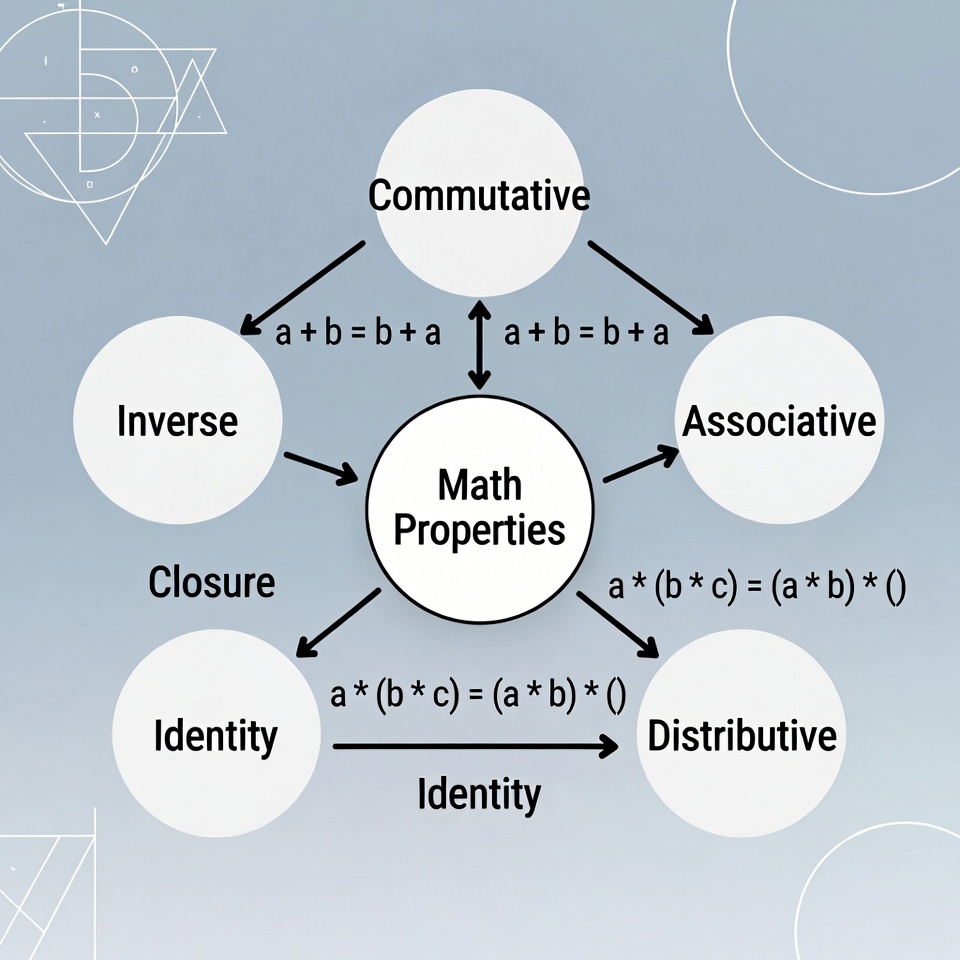
- The big ones are commutative (order), associative (grouping), distributive (multiplying across a sum), identity (adding 0 or multiplying by 1) and inverse (undoing an operation to get 0 or 1).
- Commutative and associative work for addition and multiplication only. They fail for subtraction and division.
- These properties are the engine behind mental math now and algebra later. 3(x + 5) = 3x + 15 is just the distributive property.
Math properties are rules that hold for every number, so you can reorder, regroup or split a problem and still get the same answer. The main ones kids learn are the commutative, associative, distributive, identity and inverse properties, plus the zero property of multiplication. For example, the commutative property says 6 + 9 = 9 + 6, and the distributive property says 4 × (10 + 2) = 4 × 10 + 4 × 2.
Kids usually meet these names in third grade and see them again every year through algebra. Below you’ll find each property with a plain definition and real numbers, a one-table cheat sheet, where each one fails, and why they matter far more than a vocabulary quiz suggests.
The math properties cheat sheet
| Property | What it says | Addition | Multiplication |
|---|---|---|---|
| Commutative | Order doesn’t matter | a + b = b + a | a × b = b × a |
| Associative | Grouping doesn’t matter | (a + b) + c = a + (b + c) | (a × b) × c = a × (b × c) |
| Identity | One number leaves others unchanged | a + 0 = a | a × 1 = a |
| Inverse | Every number has a partner that “cancels” it | a + (-a) = 0 | a × (1/a) = 1, when a isn’t 0 |
| Distributive | Multiplication spreads over addition | a × (b + c) = a × b + a × c | |
| Zero property | Anything times 0 is 0 | (none) | a × 0 = 0 |
Commutative and associative properties
Commutative property: order doesn’t matter
“Commute” means to travel, and in this property the numbers travel to new spots. For addition and multiplication, swapping the order gives the same answer.
8 + 5 = 13 and 5 + 8 = 13
7 × 6 = 42 and 6 × 7 = 42
This one quietly cuts the number of multiplication facts a kid needs to memorize almost in half. If they know 3 × 8, they already know 8 × 3.
Where it breaks: subtraction and division aren’t commutative.
10 – 4 = 6, but 4 – 10 = -6
12 ÷ 4 = 3, but 4 ÷ 12 = 1/3
Associative property: grouping doesn’t matter
The associative property is about which pair you work on first. With only addition, or only multiplication, you can move the parentheses around freely.
(2 + 7) + 3 = 9 + 3 = 12
2 + (7 + 3) = 2 + 10 = 12
(5 × 2) × 9 = 10 × 9 = 90
5 × (2 × 9) = 5 × 18 = 90
Kids often confuse this with commutative. Here’s a quick test: if the numbers stay in the same order and only the parentheses move, it’s associative. If the numbers swap places, it’s commutative.
Where it breaks:
(10 – 5) – 2 = 5 – 2 = 3
10 – (5 – 2) = 10 – 3 = 7
Different answers, so subtraction isn’t associative. Division fails too: (16 ÷ 4) ÷ 2 = 2, but 16 ÷ (4 ÷ 2) = 8.
Distributive property: the one that matters most
The distributive property says that multiplying a number by a sum is the same as multiplying it by each part and adding the results.
a × (b + c) = a × b + a × c
Worked example: 7 × 23. Split 23 into 20 + 3.
7 × 23 = 7 × (20 + 3)
= 7 × 20 + 7 × 3
= 140 + 21
= 161
It works with subtraction too, which makes some problems very fast. Try 9 × 98:
9 × 98 = 9 × (100 – 2)
= 900 – 18
= 882
This is the same move kids make in algebra. 3(x + 5) becomes 3x + 15. Running it backward is factoring: 4x + 12 = 4(x + 3). And combining like terms, 5x + 3x = 8x, is the distributive property too, since 5x + 3x = (5 + 3)x. A child who’s shaky here will hit a wall in pre-algebra, which is a big reason we wrote about why algebra trouble usually starts years earlier.
Identity, inverse and zero properties
Identity property
The identity is the number that leaves everything unchanged. For addition it’s 0. For multiplication it’s 1.
34 + 0 = 34
34 × 1 = 34
The multiplication identity is the reason equivalent fractions work. 2/3 × 4/4 = 8/12, and since 4/4 is just 1, the value didn’t change.
Inverse property
The additive inverse of a number is its opposite. Add them and you get 0: 15 + (-15) = 0.
The multiplicative inverse is the reciprocal. Multiply them and you get 1: 3/4 × 4/3 = 12/12 = 1. Zero is the one number with no reciprocal, since nothing times 0 equals 1.
Inverses are how kids solve equations. To solve x + 8 = 20, subtract 8 from both sides (using the additive inverse) to get x = 12.
Zero property of multiplication
Any number times 0 is 0. 58 × 0 = 0, and so does 0 × 1,000,000. Don’t mix it up with the identity property of addition, where adding 0 leaves the number alone.
Using math properties for mental math
These rules earn their keep when kids use them to make arithmetic easier. Two examples:
Find friendly pairs. 17 + 38 + 62. Group the 38 and 62 first, since they make 100 (associative).
17 + (38 + 62) = 17 + 100 = 117
Rearrange to make 100. 4 × 37 × 25. Swap to put 4 and 25 together (commutative), then group them (associative).
4 × 25 × 37 = 100 × 37 = 3,700
A kid who can do these in their head understands the properties. A kid who can only recite the names has memorized vocabulary.
Common mistakes with math properties
- Swapping the order in subtraction. Writing 3 – 8 as if it were 8 – 3. This shows up as answers with the wrong sign.
- Distributing to only the first term. 5(x + 4) written as 5x + 4 instead of 5x + 20. It’s the most common algebra error tied to properties.
- Mixing up commutative and associative. Use the test above: did the numbers move, or only the parentheses?
- Thinking a number times 0 is the number. That confuses the zero property with the identity property of addition.
- Distributing over multiplication. 2 × (3 × 5) is 30, not (2 × 3) × (2 × 5) = 60. Distribution only spreads over addition and subtraction.
Practice problems
For 1 to 5, name the property.
- 7 + 12 = 12 + 7
- 9 × 1 = 9
- (4 × 5) × 2 = 4 × (5 × 2)
- -15 + 15 = 0
- 6 × (10 + 3) = 6 × 10 + 6 × 3. Which property is this, and what’s the answer?
- Use the distributive property to find 8 × 47.
- Find 25 × 13 × 4 in your head. Which properties did you use?
- Simplify 3(x + 5) + 2x.
Answers
- Commutative property of addition.
- Identity property of multiplication.
- Associative property of multiplication. Both sides equal 40.
- Inverse property of addition.
- Distributive property. 60 + 18 = 78.
- 8 × (40 + 7) = 320 + 56 = 376.
- Reorder to 25 × 4 × 13 (commutative), then group (25 × 4) × 13 (associative): 100 × 13 = 1,300.
- 3x + 15 + 2x = 5x + 15.
If your child is stuck on properties
Trouble with math properties usually isn’t about the names. If a child can’t see why 7 × 23 = 140 + 21, the gap is typically place value (seeing 23 as 20 + 3) or shaky multiplication facts. If they distribute wrong in algebra, it often traces back to never really understanding what multiplication means as equal groups.
Those are grade 3 to 5 skills, and our guide to math skills by grade level lays out when each one is expected. If you’re unsure whether this is one weak spot or a pattern, these 12 signs by grade level are a good gut check.
Frequently asked questions
What are the 4 properties of math?
Most lists name commutative, associative, distributive and identity. Many teachers add the inverse property and the zero property of multiplication, which makes six.
What’s the difference between commutative and associative?
Commutative is about order (numbers swap places). Associative is about grouping (the parentheses move, the numbers stay put).
Is subtraction commutative?
No. 9 – 2 = 7, but 2 – 9 = -7. Division isn’t commutative either.
What grade learns math properties?
Kids start using commutative, associative and distributive ideas with whole numbers around grade 3. They extend them to fractions and variables in grades 6 and 7, and use all of them constantly in algebra.
What are the properties of equality?
Those are a related set used in solving equations: reflexive (a = a), symmetric (if a = b, then b = a) and transitive (if a = b and b = c, then a = c), along with rules that let you add, subtract, multiply or divide both sides by the same number.
Find the actual gap
When properties don’t click, a skill underneath them is usually missing, and guessing which one wastes weeks. Math Anon begins with a short adaptive assessment that finds the specific gaps and gives you a written report.
Then your child practices about 20 minutes a day on exactly those skills, and you get a progress report each week. The assessment costs $49, credited back in full on your first month. Start the assessment, or check pricing.
Related reading
- Struggling With Algebra? The Real Problem Is Usually Fourth Grade Fractions
- Math Skills By Grade Level: What Your Child Should Know
- Is My Child Behind In Math? 12 Signs By Grade Level
- Mind The Gap: A Parent’s Guide To Math Assessment For Kids
- The Transitive Property: Equality, Inequality And Geometry





