
Adding Integers: Rules, Examples And Practice
The short version
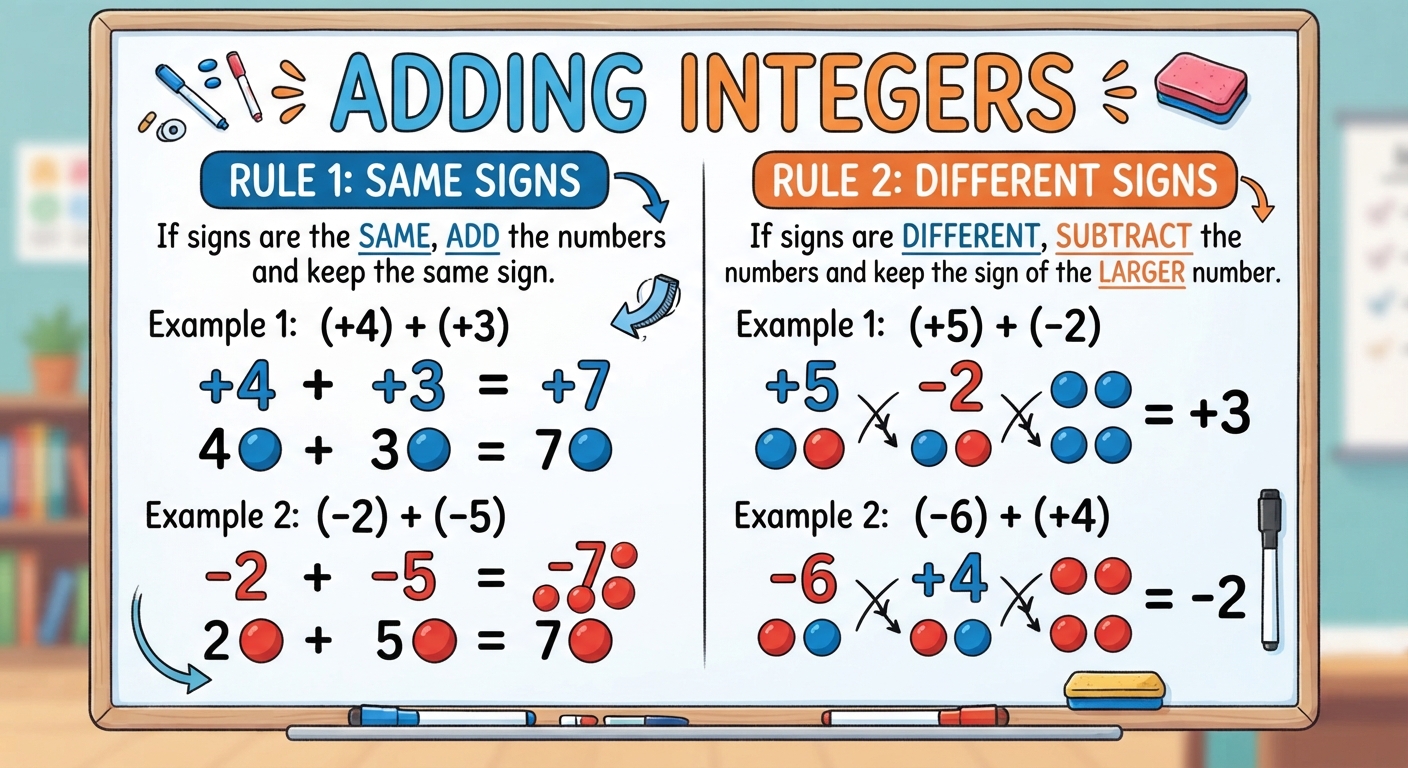
- Same signs: add the numbers and keep the sign. -8 + (-5) = -13.
- Different signs: subtract the smaller absolute value from the larger one, then use the sign of the number that’s farther from zero. -12 + 7 = -5.
- A number plus its opposite is always zero: -6 + 6 = 0.
- On a number line, adding a positive moves right and adding a negative moves left.
Adding integers comes down to two rules. If the signs match, add the numbers and keep that sign. If the signs are different, subtract the smaller absolute value from the larger one and keep the sign of whichever number is farther from zero. So -9 + (-4) = -13, and -9 + 4 = -5.
Below we explain why those rules work (a number line and a money model), walk through worked examples including long strings of integers, list the mistakes that cost the most points, and finish with practice problems and an answer key.
What integers are, and what absolute value means
Integers are the whole numbers, their opposites, and zero: …, -3, -2, -1, 0, 1, 2, 3, …. No fractions or decimals. Negative integers show up anywhere you can go below a starting point: temperatures below zero, money you owe, depth below sea level, yards lost in football.
Absolute value is a number’s distance from zero, ignoring direction. It’s written with bars: |-7| = 7 and |7| = 7. You need absolute value for adding integers because the rules compare sizes, and the size of -12 is 12.
The rules for adding integers
| Case | What to do | Example |
|---|---|---|
| Positive + positive | Add as usual. Answer is positive. | 6 + 9 = 15 |
| Negative + negative | Add the absolute values. Answer is negative. | -6 + (-9) = -15 |
| Positive + negative | Subtract the absolute values. Keep the sign of the larger one. | 15 + (-9) = 6 |
| Negative + positive | Same as above. | -15 + 9 = -6 |
| Number + its opposite | They cancel. | -11 + 11 = 0 |
The parentheses in -6 + (-9) are there so two signs don’t sit next to each other. It means “negative 6 plus negative 9.”
Why the rules work
Kids forget rules they don’t understand. These two pictures make the rules feel obvious, and a kid who gets one of them can rebuild the rule on a test.
The number line
Start at the first number. Adding a positive means move right. Adding a negative means move left.
For -3 + 8: start at -3, move 8 to the right. You pass 0 after 3 steps, then keep going 5 more. You land on 5.
For 4 + (-10): start at 4, move 10 to the left. You reach 0 after 4 steps and keep going 6 more. You land on -6.
That “reach zero, then keep going” is the subtraction in the different signs rule. The part left over after zero is the difference of the absolute values.
Money
Think of positives as dollars you have and negatives as dollars you owe.
You owe $8 and then owe $5 more: -8 + (-5). Now you owe $13, so the answer is -13. Debts pile up, and that’s the same signs rule.
You owe $12 and earn $7: -12 + 7. The $7 pays off part of the debt, and you still owe $5, so the answer is -5. Whichever side is bigger wins, and the difference is what’s left.
Worked examples of adding integers
Example 1: two negatives
-14 + (-23)
Same signs, so add: 14 + 23 = 37.
Keep the negative sign: -37.
Example 2: different signs, positive wins
-19 + 46
Different signs, so subtract absolute values: 46 – 19 = 27.
46 is farther from zero and it’s positive: 27.
Example 3: different signs, negative wins
32 + (-50)
Subtract absolute values: 50 – 32 = 18.
-50 is farther from zero: -18.
Example 4: a string of integers
-4 + 9 + (-7) + 3 + (-12)
Because order doesn’t matter in addition, group the positives and the negatives.
Positives: 9 + 3 = 12.
Negatives: -4 + (-7) + (-12) = -23.
Now combine: 12 + (-23) = -11.
Grouping like this means you only apply the different signs rule once, which cuts down on sign errors.
Example 5: a word problem
At 6 a.m. it’s -7°F. By noon the temperature has gone up 12 degrees. What’s the noon temperature?
-7 + 12. Subtract: 12 – 7 = 5. 12 is larger and positive.
It’s 5°F at noon.
Example 6: decimals and fractions
The same rules apply to any signed numbers, not only integers.
-2.5 + 6.75: 6.75 – 2.5 = 4.25, positive wins, so 4.25.
-3/4 + 1/2: rewrite as -3/4 + 2/4. 3/4 – 2/4 = 1/4, negative wins, so -1/4.
Common mistakes when adding integers
- Keeping the sign of the first number. A kid who writes -3 + 10 = -7 has subtracted correctly but grabbed the wrong sign. 10 is farther from zero, so the answer is 7.
- Adding when the signs differ. -9 + 4 written as -13. The signs are different, so this is a “pay off part of the debt” problem: 9 – 4 = 5, and the answer is -5.
- Assuming any negative makes the answer negative. -2 + 20 is 18. Check which number is bigger before picking a sign.
- Mixing up the adding and subtracting rules. “Two negatives make a positive” is a multiplication rule. -5 + (-5) is -10, not 10.
- Losing a sign in a long string. Working left to right through six numbers invites slips. Group positives and negatives first.
Practice problems
1. 6 + (-2)
2. -5 + (-9)
3. -11 + 4
4. -3 + 17
5. 25 + (-40)
6. -8 + 13 + (-6) + (-2)
7. A diver is 30 feet below the surface, at -30 feet. She swims up 18 feet. What’s her new position?
8. -3/4 + 5/8
Answers
1. Different signs: 6 – 2 = 4, positive wins. 4
2. Same signs: 5 + 9 = 14, keep negative. -14
3. Different signs: 11 – 4 = 7, negative wins. -7
4. Different signs: 17 – 3 = 14, positive wins. 14
5. Different signs: 40 – 25 = 15, negative wins. -15
6. Positives: 13. Negatives: -8 + (-6) + (-2) = -16. Then 13 + (-16) = -3.
7. -30 + 18: 30 – 18 = 12, negative wins. -12 feet, or 12 feet below the surface.
8. -6/8 + 5/8: 6/8 – 5/8 = 1/8, negative wins. -1/8
If your child is stuck on adding integers
Integers usually arrive in sixth grade, and adding and subtracting them is a core seventh grade skill. When a kid keeps missing these, the sign rules are often fine on paper and something older is shaky underneath.
The common gaps we see are subtraction fluency (every different signs problem hides a subtraction), comparing sizes of numbers, and a missing picture of what negative numbers mean. A student who can’t place -7 on a number line is memorizing rules without a map, and those rules fall apart under test pressure. That pressure can also turn into avoidance, which we cover in Math Anxiety In Children.
This is worth fixing early. Algebra is full of signed numbers, from combining like terms to solving 3x + 7 = -8, and our post on struggling with algebra explains how small early gaps grow. Short regular practice works better than a weekend cram for sign rules, for the reasons in Why 20 Minutes A Day Beats A 90-Minute Tutoring Session.
Frequently asked questions
What is the rule for adding integers?
If the signs are the same, add and keep the sign. If they’re different, subtract the absolute values and keep the sign of the number farther from zero.
What is a negative plus a negative?
Always a negative. Add the absolute values and put a negative sign in front: -7 + (-8) = -15.
What is a negative plus a positive?
It depends which is larger. -10 + 3 = -7 because the negative is bigger, but -3 + 10 = 7 because the positive is bigger.
Does the order matter when adding integers?
No. Addition is commutative, so -5 + 8 and 8 + (-5) are both 3. That’s why you can regroup positives and negatives in a long problem.
What grade learns adding integers?
Most students meet negative numbers in sixth grade and learn to add and subtract them in seventh grade.
Find the actual gap
A kid who keeps getting integer signs wrong might need help with integers, or with subtraction, or with what a negative number even is. Math Anon’s short adaptive assessment sorts that out and hands you a written report showing which skills are missing.
After that it’s about 20 minutes a day of practice built around those exact skills, plus a weekly progress report so you can see it working. The assessment is $49, and we credit the full amount back on your first month. Start the assessment or check pricing.





