
The Commutative Property Of Addition And Multiplication
The short version
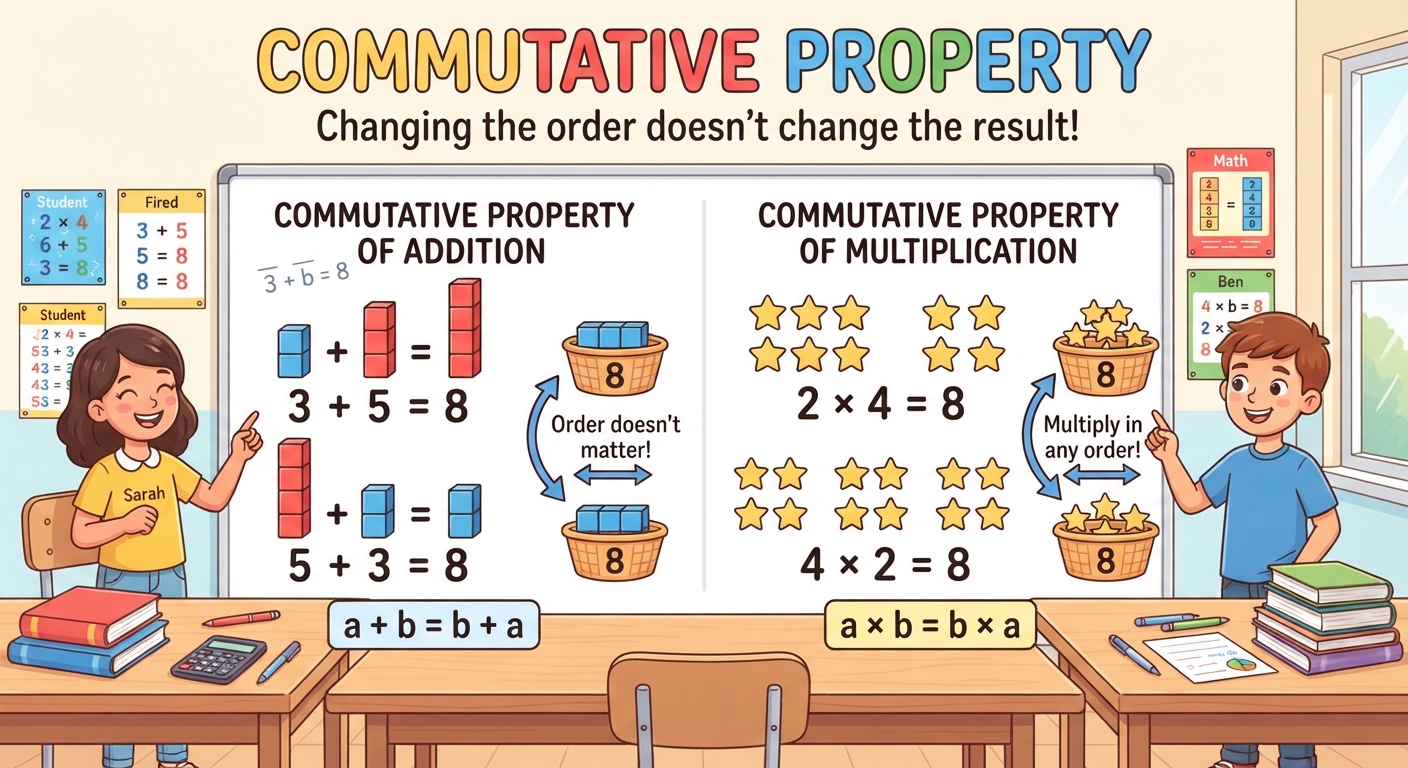
- The commutative property says you can swap the order of two numbers in addition or multiplication and the answer stays the same. 7 + 26 = 26 + 7, and 4 × 25 = 25 × 4.
- It fails for subtraction and division. 9 – 4 = 5 but 4 – 9 = -5, and 12 ÷ 3 = 4 but 3 ÷ 12 = 0.25.
- Commutative is about order. Associative is about grouping, which parentheses move. They’re different rules.
- The payoff is mental math: reorder 39 + 16 + 61 as 39 + 61 + 16 and you’re adding 100 + 16 in your head.
- It halves how many facts a kid has to memorize, because 8 × 7 and 7 × 8 are the same fact seen from two sides.
The commutative property is the rule that order doesn’t matter when you add or when you multiply. Write a + b = b + a for addition and a × b = b × a for multiplication, and that’s the whole thing. The word comes from “commute,” which means to move around, and the numbers are what move.
It sounds obvious once you see it, and that’s exactly the trap. Kids nod along at 2 + 3 = 3 + 2, then write 8 – 3 = 3 – 8 on a test. Below is what the property covers, what it never covers, how it differs from the associative and distributive properties, the shortcuts it buys you, and practice with answers.
The commutative property of addition
Add two numbers in either order and you land on the same total.
7 + 26 = 33
26 + 7 = 33
So 7 + 26 = 26 + 7
Picture six blocks and four blocks pushed together. Push the pile of four toward the six or the six toward the four, and you’re still looking at ten blocks. Nothing about the total depends on which hand moved.
It works with negatives too. 8 + (-20) gives -12, and -20 + 8 also gives -12. And it works with more than two numbers, which is where it starts saving time: 39 + 16 + 61 is a chore in that order, but reorder it as 39 + 61 + 16 and you get 100 + 16 = 116 without writing anything down.
The commutative property of multiplication
Same deal. 4 × 25 = 100 and 25 × 4 = 100.
Arrays make this one obvious. Draw 3 rows of 5 dots and count 15. Turn the page sideways and you’re looking at 5 rows of 3 dots, still 15. The dots never moved; your view did.
This is the single biggest shortcut in learning times tables. A kid who knows 8 × 7 = 56 already knows 7 × 8 = 56, so the 144 facts in a 12 by 12 table collapse to 78 you actually have to learn. Say that out loud to a kid staring at a multiplication chart.
It also rescues awkward mental math. 2 × 17 × 5 looks unpleasant left to right. Reorder to 2 × 5 × 17, get 10 × 17, and the answer is 170.
Why subtraction and division are not commutative
Subtraction and division both care about which number goes first, because both are asking a one way question.
9 – 4 = 5
4 – 9 = -5
Those are different answers, so subtraction is not commutative.
12 ÷ 3 = 4
3 ÷ 12 = 0.25
Different again, so division is not commutative.
The reason is what the operations mean. “9 – 4” asks how much is left after you take 4 away from 9. Flipping it asks a different question: how much is left after you take 9 away from 4, and the answer goes below zero. Division asks how many 3s fit inside 12. Flip it and you’re asking how many 12s fit inside 3, which is a quarter of one.
There’s one narrow exception worth knowing for test questions. a – b = b – a is true only when a and b are the same number, because both sides are then 0. 5 – 5 = 5 – 5. That’s the only case.
Commutative, associative and distributive
Three properties get taught together and mixed up constantly. Here’s what separates them.
| Property | What moves | Addition | Multiplication |
|---|---|---|---|
| Commutative | The order of the numbers | 7 + 26 = 26 + 7 | 4 × 25 = 25 × 4 |
| Associative | The grouping, meaning the parentheses | (2 + 3) + 7 = 2 + (3 + 7) | (2 × 3) × 5 = 2 × (3 × 5) |
| Distributive | A multiplier spreading across a sum | Does not apply alone | 4 × (10 + 3) = 40 + 12 |
Check the associative row: (2 + 3) + 7 is 5 + 7 = 12, and 2 + (3 + 7) is 2 + 10 = 12. The numbers stayed in the same order; only the brackets moved. Check the distributive row: 4 × 13 = 52, and 4 × 10 + 4 × 3 = 40 + 12 = 52.
A quick test for a kid who can’t tell them apart: did the numbers change places, or did the parentheses? Places means commutative. Parentheses means associative.
Where the commutative property pays off
This isn’t a vocabulary word for a quiz. It’s a working tool, and kids who use it get faster.
Counting on from the bigger number. For 3 + 19, a first grader who starts at 3 and counts up 19 times will lose track. Flipped to 19 + 3, it’s three hops.
Making tens. Scan a string of numbers for pairs that hit a round number and pull them together first. 17 + 48 + 3 becomes 17 + 3 + 48, so 20 + 48 = 68.
Rearranging factors. 25 × 7 × 4 becomes 25 × 4 × 7, so 100 × 7 = 700.
Fact families. Every multiplication fact comes with a free twin, and every addition fact does too. That’s half the flashcards gone.
Common mistakes
Applying it to subtraction. The classic. A kid facing 4 – 9 decides subtraction “has to” go big minus small, writes 5, and misses the negative. Ask them to check on a number line, where going below zero is visible.
Applying it to division. Same instinct with 3 ÷ 12. It’s a real question with the real answer 0.25, or one quarter.
Confusing it with the associative property. Seeing (4 + 6) + 5 = 4 + (6 + 5) and calling it commutative. Nothing changed order there.
Thinking it changes the operation. The commutative property lets you swap numbers, never the signs between them. 8 + 3 × 2 is not 8 × 3 + 2.
Assuming everything in math commutes. It doesn’t. Later on, matrix multiplication and function composition both break the rule, so the habit of checking is worth forming early.
Practice problems
- Fill in the blank: 14 + 9 = 9 + ___
- True or false: 6 – 2 = 2 – 6
- Fill in the blank: 25 × ___ = 4 × 25
- Reorder 39 + 16 + 61 to make it easier, then add.
- Use the commutative property to find 8 × 7 × 5 quickly.
- Is 20 ÷ 5 the same as 5 ÷ 20? Work out both.
- Which property is shown by (3 × 4) × 5 = 3 × (4 × 5)?
- Find every pair of numbers a and b where a – b = b – a.
Answers
- 14. Both sides equal 23.
- False. 6 – 2 = 4 and 2 – 6 = -4.
- 4. Both sides equal 100.
- 39 + 61 + 16 = 100 + 16 = 116.
- 8 × 5 = 40, then 40 × 7 = 280.
- No. 20 ÷ 5 = 4 and 5 ÷ 20 = 0.25.
- The associative property. The order stayed the same and only the grouping changed.
- Only pairs where a and b are equal, such as 7 and 7. Both sides are then 0.
If your child is stuck on this
Almost nobody is truly stuck on the commutative property itself. What looks like a property problem is usually one of two other things.
The first is negative numbers. A kid who writes 4 – 9 = 5 doesn’t believe the answer can go below zero yet. That’s a number line gap, and it will also wreck their integer work, their algebra and their coordinate graphing. Fix it with a number line taped to the desk, not with more property drills.
The second is vocabulary overload. Commutative, associative, distributive, identity and inverse all arrive in the same chapter, and a kid who understands every one of them in practice can still fail the matching questions. That’s a naming problem, and it’s fixed in an afternoon with a sorting activity.
If the trouble runs deeper than either of those, it helps to know what’s normally expected at each age. Our guide to math skills by grade level lays it out, and Is My Child Behind In Math? covers the signs a real gap has opened. Properties come back hard in algebra, where older gaps stop hiding.
Frequently asked questions
What is the commutative property in simple words?
You can swap the order of the numbers you’re adding or multiplying without changing the answer. 5 + 2 is the same as 2 + 5, and 5 × 2 is the same as 2 × 5.
What is the commutative property of addition?
It’s the rule a + b = b + a. Add two numbers in either order and the sum matches. It holds for whole numbers, fractions, decimals and negatives, and it extends to any string of additions.
Is subtraction commutative?
No. 10 – 7 = 3 but 7 – 10 = -3. The only time the two sides agree is when both numbers are identical, and then both answers are 0.
What is the difference between the commutative and associative properties?
Commutative changes the order of the numbers. Associative changes the grouping while the order stays put. 3 + 5 = 5 + 3 is commutative. (3 + 5) + 2 = 3 + (5 + 2) is associative.
What grade do kids learn the commutative property?
The idea shows up in first grade for addition, usually without the name. Multiplication follows in third grade, and the formal vocabulary tends to land in third to sixth grade depending on the curriculum. It gets reused throughout algebra.
Find the actual gap
When a property question goes wrong, the property is rarely the problem. Negative numbers, times tables or the number line usually are, and guessing which one costs a term. Math Anon starts every student with a short adaptive assessment that adjusts as they answer and pinpoints the missing skills, then sends you a written report naming them.
What follows is about 20 minutes a day of practice built around those specific gaps, with a weekly report showing which ones have closed. The assessment is $49, credited back in full against your first month. Start the assessment, or read the pricing page first.





