
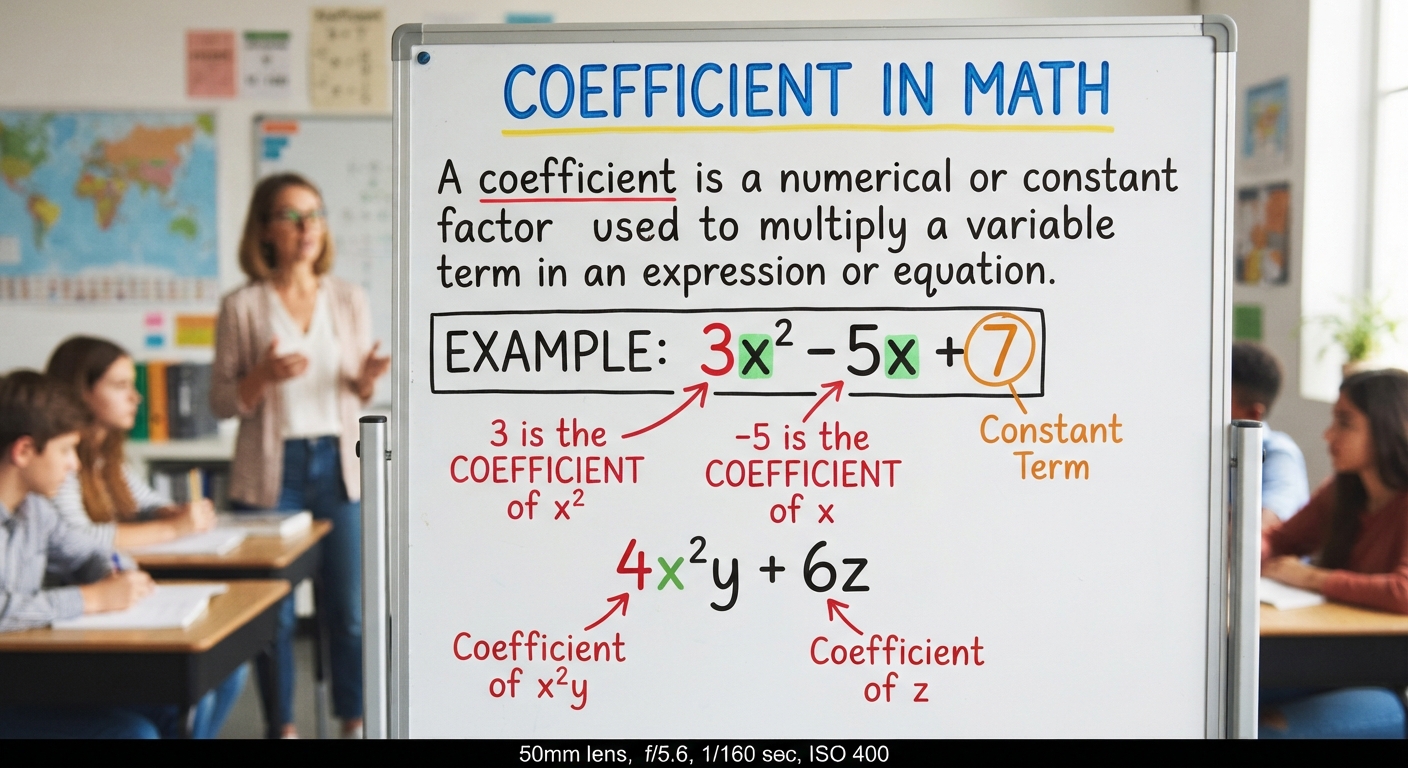
What Is A Coefficient In Math? Examples And Practice
The short version
- A coefficient is the number multiplying a variable in a term. In 7x the coefficient is 7, and in -3xy it’s -3.
- When you see no number at all, the coefficient is 1. So x means 1x, and -m means -1m.
- The sign belongs to the coefficient. In 6x² – 7x + 2 the coefficient of x is -7, not 7.
- A constant is a term with no variable attached, like the 2 in that same expression. A coefficient always has a variable riding with it.
- The leading coefficient is the one on the highest power, once the terms are written in descending order. For 5 – 8x + 3x³ it’s 3.
A coefficient is the number that multiplies a variable. Look at a term, find the letter, and the number stuck to the front of it is the coefficient. In 7x it’s 7. In 0.5y it’s 0.5. In -3xy it’s -3, sign included.
That’s the whole definition, and it takes about a minute to learn. What takes longer is spotting coefficients that are hiding, keeping the sign attached, and telling a coefficient apart from a constant on a test that asks for both. Below are the examples, the parts of an expression laid out, leading coefficients, the mistakes that cost marks, and practice with answers.
What a coefficient is
Algebra breaks an expression into terms, which are the chunks separated by plus and minus signs. Each term is a number multiplied by some letters. The number is the coefficient and the letters are the variable part.
| Term | Coefficient | Variable part |
|---|---|---|
| 7x | 7 | x |
| -3xy | -3 | xy |
| x | 1 | x |
| -m | -1 | m |
| 0.5t | 0.5 | t |
| (2/3)y | 2/3 | y |
The bottom four rows are where students lose points. A term written as just x has an invisible 1 in front of it, and -m carries an invisible -1. Coefficients don’t have to be whole numbers either; fractions and decimals count.
Coefficient, variable, constant and term
These four words show up in the same question all the time, so here they are side by side using 4x² + 7x – 9.
| Word | What it means | In 4x² + 7x – 9 |
|---|---|---|
| Term | A chunk separated by + or – | 4x², 7x and -9 |
| Variable | The letter standing for an unknown | x |
| Coefficient | The number multiplying a variable | 4 and 7 |
| Constant | A term with no variable | -9 |
Read the -9 row again. It’s a constant, not a coefficient, because there’s no variable for it to multiply. The quick test: if you can cover the number and still see a letter in that term, the number is a coefficient. If the term is only a number, it’s a constant.
One more piece of vocabulary turns up in older textbooks. In the term 5ax, the numerical coefficient is 5, but the coefficient of x is 5a, since that’s everything multiplying x. Letters that stand for fixed values, like the a and b in ax + b, are called literal coefficients.
The leading coefficient
Write a polynomial in descending order, biggest exponent first. The coefficient on that first term is the leading coefficient.
3x³ – 8x + 5
Highest power: x³
Leading coefficient: 3
The catch is that problems rarely hand you the terms in order. Given 5 – 8x + 3x³, a student who grabs the first number sitting there answers 5, which is the constant. Rearrange first, then read.
For a quadratic written ax² + bx + c, a is the leading coefficient and it does real work. Its sign decides whether the parabola opens up or down, and its size decides how narrow the curve is. In 2x² – 5x + 3, a = 2, b = -5 and c = 3, which is exactly what the quadratic formula wants.
What coefficients are actually for
Combining like terms. Terms with matching variable parts merge by adding their coefficients and leaving the variable alone. 8x + 3x = 11x. 9y – 12y = -3y. The variable never gets added to itself.
Solving equations. To undo a coefficient, divide both sides by it. 6x = 42 becomes x = 42 ÷ 6 = 7. That single move is most of one step equation solving.
Reading a graph off an equation. In y = 3x + 2, the coefficient of x is the slope, so the line climbs 3 for every 1 across, and the constant 2 is where it crosses the y axis. Change the coefficient and the steepness changes.
Describing a real situation. If tickets cost $12 each, total cost is 12n. The coefficient is the rate, the variable is how many, and the constant would be any flat fee tacked on.
Common mistakes
Dropping the negative sign. In 6x² – 7x + 2, the coefficient of x is -7. The minus sign in front of a term belongs to that term’s coefficient, always.
Saying a bare variable has no coefficient. It has one, and it’s 1. This matters the moment you combine terms: x + 4x is 5x, not 4x.
Calling the constant a coefficient. No variable, no coefficient. The -9 in 4x² + 7x – 9 is a constant term.
Reading the leading coefficient off an unsorted expression. Sort by exponent first. In 5 – 8x + 3x³ the leading coefficient is 3.
Adding the variables along with the coefficients. 8x + 3x = 11x, never 11x². You’re counting how many x you have, and the x itself doesn’t multiply.
Missing an exponent’s effect. In 4x², the 4 is the coefficient and the 2 is an exponent. Only the x gets squared, so when x = 3 the term is 4 × 9 = 36, not 144.
Practice problems
- What is the coefficient in 9m?
- What is the coefficient of x in -4x?
- What is the coefficient in the term y?
- In 6x² – 7x + 2, name the coefficient of x², the coefficient of x, and the constant.
- What is the leading coefficient of 5 – 8x + 3x³?
- Simplify 8x + 3x – 12x.
- Solve 6x = 42 by dividing by the coefficient.
- What is the numerical coefficient in the term -ab?
Answers
- 9
- -4. The sign comes with it.
- 1, because y means 1y.
- Coefficient of x² is 6, coefficient of x is -7, constant is 2.
- 3. Rewrite it as 3x³ – 8x + 5 and read the first coefficient.
- -x. The coefficients give 8 + 3 – 12 = -1, and -1x is written -x.
- x = 7, since 42 ÷ 6 = 7.
- -1. There’s no number showing, so it’s 1, and the minus sign makes it -1.
If your child is stuck on this
Coefficients arrive in fifth or sixth grade and get heavy use from seventh grade on, so a kid who stumbles here will stumble on everything built after it. The useful question is which part of the stumble it is.
If they can point at the coefficient but get the sign wrong, the gap is integer operations, meaning adding and subtracting negatives. That’s a sixth grade skill and it will also break their equation solving, their slope work and their graphing. If they add the variables together and write 11x² for 8x + 3x, the gap is what multiplication and exponents mean, which sits even further back.
Either way, more algebra practice won’t fix it. Practice the missing skill instead. Our post on why algebra falls apart walks through how old gaps surface in new chapters, Is My Child Behind In Math? gives the warning signs by grade, and math skills by grade level shows what should already be solid before variables show up.
Frequently asked questions
What is a coefficient in math in simple terms?
The number in front of a variable, telling you how many of that variable you have. In 5x you have five x, so 5 is the coefficient.
What is the coefficient of x in x + 5?
It’s 1. Writing x on its own is shorthand for 1x, and the 5 is a constant rather than a coefficient.
Can a coefficient be negative, a fraction or zero?
All three. -3xy has a coefficient of -3, and (2/3)y has a coefficient of 2/3. A coefficient of 0 wipes the term out, since 0x is just 0, which is why those terms usually don’t get written.
What is the difference between a coefficient and a constant?
A coefficient multiplies a variable. A constant stands alone with no variable in its term. In 4x² + 7x – 9, the 4 and 7 are coefficients and the -9 is the constant.
What is a leading coefficient used for?
It tells you the most about how a polynomial behaves. For a quadratic, its sign says whether the parabola opens upward or downward and its size says how narrow the curve is. It’s also the a in the quadratic formula.
Find the actual gap
A wrong answer on a coefficient question is usually a message about something older, and the message is easy to misread at the kitchen table. Math Anon starts with a short adaptive assessment that adjusts with every answer, so it finds the exact skills that are missing rather than the ones the current chapter happens to cover. You get a plain English report listing them.
From there it’s around 20 minutes of daily targeted practice on those skills, with a weekly progress report so you can see what’s been closed out. The assessment costs $49 and the whole amount is credited back on your first month. Start the assessment, or look through the pricing first.





