
What Is A Conjugate In Math? Rules And Examples
The short version
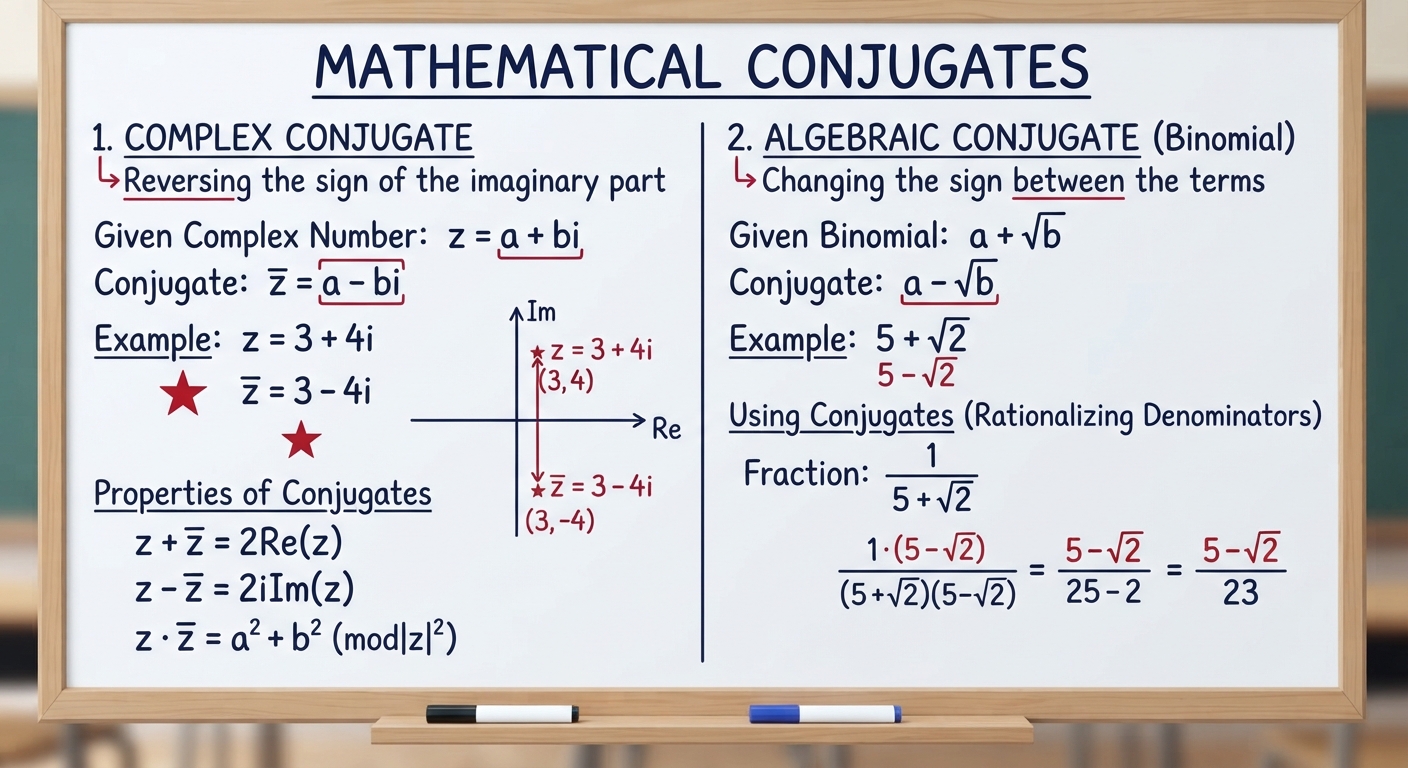
- A conjugate is what you get when you flip the sign between the two terms of a binomial. The conjugate of 5 + √3 is 5 – √3, and the conjugate of 3 + 2i is 3 – 2i.
- Multiply a pair of conjugates and the middle terms cancel, leaving a² – b². That’s why (5 + √3)(5 – √3) = 25 – 3 = 22, with no radical left.
- Use one to rationalize a denominator: multiply the top and bottom by the conjugate of the bottom. 6 ÷ (√5 + 2) becomes 6√5 – 12.
- Complex conjugates work the same way and turn a division into something real on the bottom, because (a + bi)(a – bi) = a² + b².
- Only the sign in the middle changes. The terms themselves stay exactly where they are.
A conjugate in math is a two term expression with the middle sign flipped. Start with a + b and its conjugate is a – b. Start with 7 – √2 and its conjugate is 7 + √2. Nothing else about the expression moves, which is the part kids get wrong most.
The reason anyone cares is what happens when you multiply the pair together: every term with a radical or an i in it cancels out and you’re left with plain numbers. That single trick is how you clear a square root out of a denominator and how you divide complex numbers. Here’s the pattern, the worked examples, the mistakes, and practice with answers.
What a conjugate is
Take any binomial, meaning an expression with exactly two terms joined by a plus or a minus. Swap that sign and you have the conjugate.
| Expression | Its conjugate |
|---|---|
| x + 4 | x – 4 |
| 7 – √2 | 7 + √2 |
| √5 + √3 | √5 – √3 |
| 3 + 2i | 3 – 2i |
| -6 – 5i | -6 + 5i |
Look at that last row carefully. The leading -6 keeps its sign. Only the operator sitting between the two terms changes. Conjugates also come in pairs, so each expression in the left column is the conjugate of the one on its right.
Why multiplying conjugates cleans things up
Multiply (a + b)(a – b) out term by term and watch what happens.
a × a = a²
a × (-b) = -ab
b × a = +ab
b × (-b) = -b²
The -ab and +ab cancel, leaving a² – b²
That’s the difference of squares, and it’s the whole engine. Squaring kills a square root, and squaring kills an i. So:
(5 + √3)(5 – √3) = 5² – (√3)² = 25 – 3 = 22
(√7 + 2)(√7 – 2) = 7 – 4 = 3
(3 + 2i)(3 – 2i) = 9 – 4i² = 9 + 4 = 13
The complex case flips to a plus because i² = -1, so subtracting 4i² is the same as adding 4. Worth writing on a sticky note: a conjugate pair with i in it always multiplies to a² + b².
Rationalizing a denominator with a conjugate
A fraction with a radical on the bottom is considered unsimplified in most algebra classes. The fix has three steps.
- Find the conjugate of the denominator.
- Multiply the numerator and the denominator by it. You’re multiplying by 1, so the value doesn’t change.
- Simplify. The bottom loses its radical.
Example 1: a whole number on top
Rationalize 6 ÷ (√5 + 2).
Conjugate of the denominator: √5 – 2
Top: 6(√5 – 2) = 6√5 – 12
Bottom: (√5)² – 2² = 5 – 4 = 1
Answer: 6√5 – 12
Example 2: the denominator has the minus
Rationalize 4 ÷ (3 – √2).
Conjugate: 3 + √2
Top: 4(3 + √2) = 12 + 4√2
Bottom: 3² – (√2)² = 9 – 2 = 7
Answer: (12 + 4√2) ÷ 7
Example 3: radicals on both floors
Simplify (√3 + 1) ÷ (√3 – 1).
Conjugate of the bottom: √3 + 1
Top: (√3 + 1)(√3 + 1) = 3 + √3 + √3 + 1 = 4 + 2√3
Bottom: (√3)² – 1² = 3 – 1 = 2
Answer: (4 + 2√3) ÷ 2 = 2 + √3
That last simplification matters. Both terms on top divide by 2, so the fraction collapses. Kids who stop at (4 + 2√3) ÷ 2 usually lose a point.
Complex conjugates
The complex conjugate of a + bi is a – bi, often written with a bar over the letter. Its main job is dividing complex numbers, because you can’t leave an i downstairs any more than you can leave a radical there.
Divide (4 + i) by (2 – 3i).
Conjugate of the denominator: 2 + 3i
Top: (4 + i)(2 + 3i) = 8 + 12i + 2i + 3i² = 8 + 14i – 3 = 5 + 14i
Bottom: (2 – 3i)(2 + 3i) = 4 + 9 = 13
Answer: (5 + 14i) ÷ 13, or 5/13 + (14/13)i
Two facts fall out of this and both get tested. Multiply a complex number by its conjugate and you always get a real number, a² + b². Add a complex number to its conjugate and the imaginary parts cancel, so that’s real too: (3 + 2i) + (3 – 2i) = 6.
Conjugate, opposite and reciprocal
These three get confused because all of them involve “flipping” something. They flip different things.
| Name | What changes | Applied to 3 + √5 |
|---|---|---|
| Conjugate | The sign between the two terms | 3 – √5 |
| Opposite | The sign of the whole expression | -3 – √5 |
| Reciprocal | The expression flips into a denominator | 1 ÷ (3 + √5) |
The opposite row is the one to check twice. Taking the opposite of 3 + √5 changes both signs, because you’re multiplying the whole thing by -1. The conjugate changes only one.
Common mistakes
Changing both signs. Writing the conjugate of 3 + 2i as -3 – 2i. That’s the opposite, not the conjugate. Only the middle operator moves.
Multiplying only the denominator. If you multiply the bottom by the conjugate and leave the top alone, you’ve changed the value of the fraction. Both floors, every time.
Forgetting that i² = -1. Students write (3 + 2i)(3 – 2i) = 9 – 4i² and stop, or turn it into 9 – 4. The right move is 9 + 4 = 13.
Distributing the top incorrectly. The denominator collapses into a difference of squares, but the numerator does not. It needs every term multiplied out.
Not simplifying at the end. (4 + 2√3) ÷ 2 reduces to 2 + √3. Check whether every term on top shares a factor with the bottom.
Using a conjugate on a single term. For 1 ÷ √7 there’s no middle sign to flip. Just multiply top and bottom by √7 to get √7 ÷ 7.
Practice problems
- Write the conjugate of 7 – √2.
- Write the conjugate of 5 + 3i.
- Multiply (4 + √3)(4 – √3).
- Multiply (2 – 5i)(2 + 5i).
- Rationalize 6 ÷ (√5 + 2).
- Rationalize 4 ÷ (3 – √2).
- Simplify (√3 + 1) ÷ (√3 – 1).
- Divide (4 + i) by (2 – 3i).
Answers
- 7 + √2
- 5 – 3i
- 16 – 3 = 13
- 4 – 25i² = 4 + 25 = 29
- 6√5 – 12, since the denominator becomes 5 – 4 = 1
- (12 + 4√2) ÷ 7
- 2 + √3, after reducing (4 + 2√3) ÷ 2
- (5 + 14i) ÷ 13, which is 5/13 + (14/13)i
If your child is stuck on conjugates
Conjugate work lands in Algebra 2, and by then a wrong answer almost never means the student misunderstood the word. Watch where the work breaks down and the real gap names itself.
If they can state the conjugate but the arithmetic falls apart, the gap is distributing two binomials or handling signed numbers. If the fraction at the end never gets reduced, the gap is fraction simplification from fifth and sixth grade. If (√3)² becomes anything other than 3, the gap is what a square root means. Each of those is fixable in days, and none of them is what the chapter is about.
This is the pattern all through high school math: the new topic is fine and something from years earlier is what’s actually failing. We wrote about it at length in Struggling With Algebra?, and Is My Child Behind In Math? lists what the signs look like by grade. If you’re weighing extra help, our breakdown of what a math tutor costs covers the options.
Frequently asked questions
What is a conjugate in math, in one sentence?
It’s the same two term expression with the sign between the terms reversed, so a + b pairs with a – b.
Why do we rationalize the denominator?
Partly convention and partly usefulness. A radical on the bottom makes two answers hard to compare and makes hand estimation awkward, since dividing by a messy decimal is worse than multiplying by one. Most teachers still require it, so it’s worth doing.
What is the conjugate of a single term like √5?
There isn’t one in the usual sense, because a conjugate needs two terms with a sign between them. To rationalize 1 ÷ √5, multiply the top and bottom by √5 and you get √5 ÷ 5.
What is a complex conjugate used for?
Dividing complex numbers, finding the size of one, and factoring. Multiplying a + bi by a – bi gives a² + b², which is always a real number, and that’s what makes the division work.
Is a conjugate the same as an opposite?
No. The opposite of 3 + 2i is -3 – 2i, with both signs flipped. The conjugate is 3 – 2i, with only the middle sign flipped.
Find the actual gap
If Algebra 2 is the point where things came apart, the cause is usually sitting a few years back and nobody has named it yet. Math Anon opens with a short adaptive assessment that changes as your child answers, so it finds the specific skills that are missing instead of the grade they’re in. You get a written report that spells out what it found.
Then it’s roughly 20 minutes of daily practice built around those gaps, and a progress report every week so you can see the list shrink. The assessment is $49, and the full amount comes back as credit on your first month. Start the assessment, or read the pricing details first.
Related reading
- Struggling With Algebra? The Real Problem Is Usually Fourth Grade Fractions
- Is My Child Behind In Math? 12 Signs By Grade Level
- How Much Does A Math Tutor Cost? Private, Center And Online Rates
- Mind The Gap: A Parent’s Guide To Math Assessment For Kids
- Why 20 Minutes A Day Beats A 90-Minute Tutoring Session





