
What Is An Equation In Math? Parts And Steps
The short version
- An equation is a math sentence saying two things are equal, with an equal sign in the middle: 3 + 2 = 5, or x + 4 = 10.
- An expression has no equal sign. 5x + 2 is an expression; 5x + 2 = 12 is an equation. You simplify expressions and you solve equations.
- To solve one, do the same operation to both sides until the variable stands alone. Whatever you do to the left, do to the right.
- Undo operations in reverse order: strip away addition and subtraction first, then multiplication and division.
- Always check by putting your answer back into the original equation. If both sides match, you’re done, and it takes about ten seconds.
An equation is a statement that two amounts are equal, written with an equal sign between them. 7 = 7 is an equation. 3 + 2 = 5 is an equation. x + 4 = 10 is an equation, and this one has a job for you: find the value of x that makes it true.
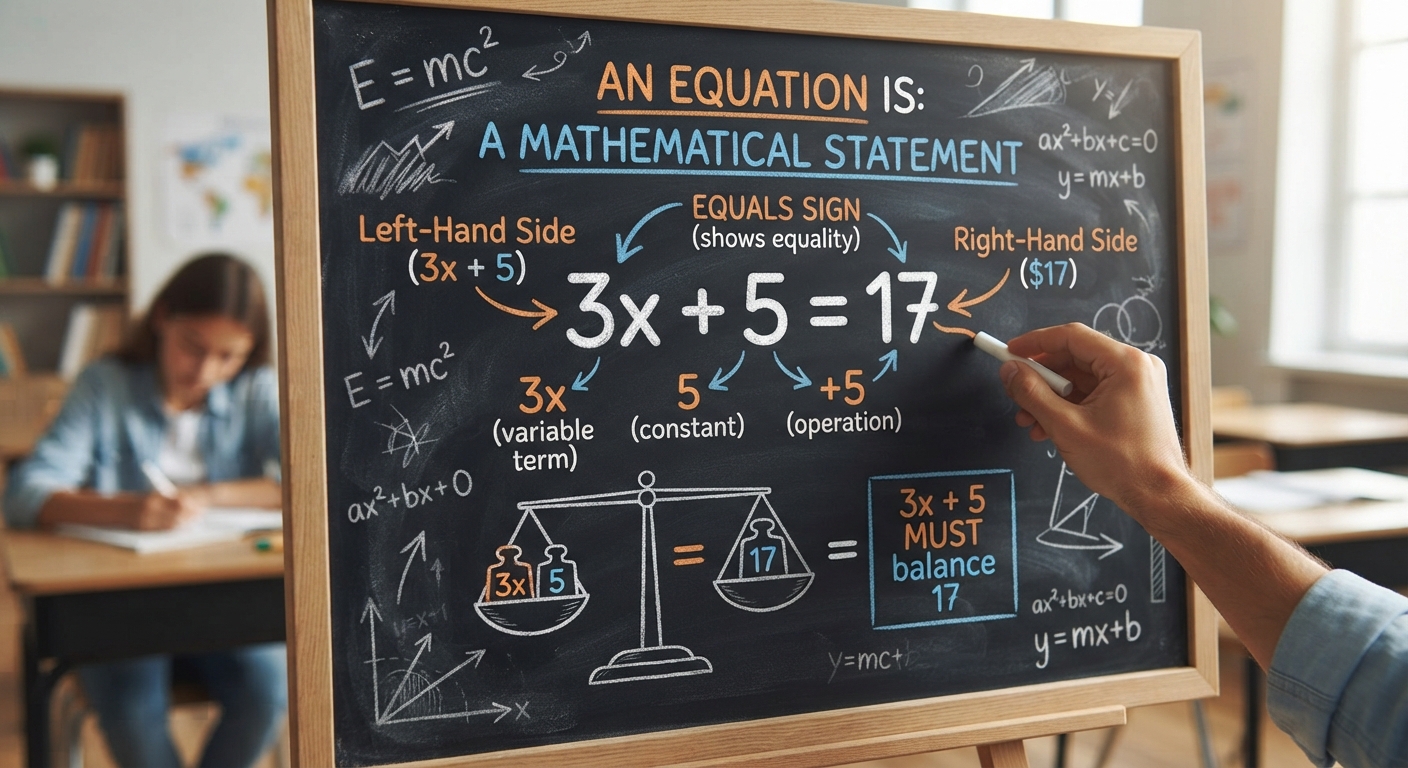
Picture a balance scale. The equal sign is the pivot and both sides hold the same weight, which explains every rule for solving: take 3 off one side and the scale tips, so take 3 off the other side too. Here’s what an equation is made of, how it differs from an expression, and how to solve and check one.
Equation vs expression
This is the distinction students lose the most points on, and the test is one second long: look for the equal sign.
| Example | What it is | What you do with it |
|---|---|---|
| 8 + 3 | Expression | Simplify it to 11 |
| 8 + 3 = 11 | Equation | Check whether it’s true |
| 5x + 2 | Expression | Simplify or evaluate for a given x |
| 5x + 2 = 12 | Equation | Solve for x |
| 5x + 2 > 12 | Inequality | Solve for a range of x values |
An expression is a phrase. An equation is a full sentence, with the equal sign as the verb. “Simplify” wants an expression back; “solve” wants a value.
The parts of an equation
Take 4x + 7 = 31 apart:
- Left side: 4x + 7. Right side: 31. The equal sign separates them.
- Terms: 4x, 7, and 31. Terms are the chunks separated by + and – signs.
- Variable: x, the unknown you’re hunting for.
- Coefficient: 4, the number multiplying the variable.
- Constants: 7 and 31, plain numbers with no variable attached.
- Operators: the + sign, and the invisible multiplication between 4 and x.
A solution is any value of the variable that makes both sides equal. Most equations kids meet have exactly one, though some have none and a few are true for every number.
Equation, formula, or inequality?
A formula is an equation holding a rule you reuse, like A = lw for the area of a rectangle. An inequality swaps the equal sign for >, <, ≥, or ≤, so its answer is a range. Rearranging one works the same way, with one twist: multiplying or dividing by a negative flips the sign.
How to solve an equation
One rule covers everything: keep the scale balanced. Any operation you apply to one side gets applied to the other side, and you pick operations that peel layers off the variable.
Example 1: one step, x + 7 = 12
The 7 is being added, so subtract 7 from both sides.
x + 7 – 7 = 12 – 7
x = 5
Check: 5 + 7 = 12. True.
Example 2: one step, 3x = 21
The x is multiplied by 3, so divide both sides by 3.
3x ÷ 3 = 21 ÷ 3
x = 7
Check: 3 × 7 = 21. True.
Example 3: two steps, 2x + 5 = 17
Undo the addition first, then the multiplication.
2x + 5 – 5 = 17 – 5
2x = 12
2x ÷ 2 = 12 ÷ 2
x = 6
Check: 2(6) + 5 = 12 + 5 = 17. True.
Example 4: variables on both sides, 4x – 3 = 2x + 9
Get all the x terms on one side first. Subtract 2x from both sides.
4x – 2x – 3 = 2x – 2x + 9
2x – 3 = 9
Add 3 to both sides: 2x = 12
Divide by 2: x = 6
Check: left side 4(6) – 3 = 21, right side 2(6) + 9 = 21. Both 21, so it holds.
Example 5: parentheses, 2(x + 3) = 16
Distribute first.
2x + 6 = 16
Subtract 6: 2x = 10
Divide by 2: x = 5
Check: 2(5 + 3) = 2 × 8 = 16. True.
The order to undo things
Solving runs the order of operations backwards. Strip the addition and subtraction off first, then the multiplication and division, and distribute over parentheses whenever it makes the work shorter.
Always check your answer
Substitute your value back into the original equation and compute both sides separately. If they match, you’re right, and no answer key is needed. That habit catches nearly every sign error and arithmetic slip.
For 3x – 4 = 20 with an answer of x = 8: the left side is 3(8) – 4 = 20, and the right side is 20. Match, so x = 8 is correct.
Common mistakes when solving an equation
Only changing one side. Writing 2x + 5 = 17, then 2x = 17, throws the balance away. Subtract 5 from both sides or the equation stops being true.
Undoing in the wrong order. Dividing 2x + 5 = 17 by 2 first gives x + 2.5 = 8.5, still true but messier. Take off the added number first.
Losing the sign. In 4x – 3, the term is negative 3. Students who treat it as positive 3 get an answer that fails the check every time.
Solving an expression. With no equal sign there’s nothing to solve. Simplify 5x + 2 and stop.
Forgetting to distribute to every term. 2(x + 3) is 2x + 6, not 2x + 3. The 2 touches both terms inside.
Practice problems
1. Which one is an equation: 5x + 2, 5x + 2 = 12, or 5x > 2?
2. Solve: x + 9 = 15
3. Solve: 7x = 56
4. Solve: x ÷ 5 = 12
5. Solve: 3x – 4 = 20
6. Solve: 5x + 3 = 3x + 11
7. Solve: 2(x + 3) = 16
8. A number multiplied by 4, then increased by 7, gives 31. Write the equation and solve it.
Answers
1. 5x + 2 = 12. The first has no equal sign, so it’s an expression, and the third is an inequality.
2. Subtract 9 from both sides: x = 6. Check: 6 + 9 = 15.
3. Divide both sides by 7: x = 8. Check: 7 × 8 = 56.
4. Multiply both sides by 5: x = 60. Check: 60 ÷ 5 = 12.
5. Add 4 to both sides to get 3x = 24, then divide by 3: x = 8. Check: 3(8) – 4 = 20.
6. Subtract 3x from both sides to get 2x + 3 = 11, subtract 3 to get 2x = 8, divide by 2: x = 4. Check: left 5(4) + 3 = 23, right 3(4) + 11 = 23.
7. Distribute to get 2x + 6 = 16, subtract 6 to get 2x = 10, divide by 2: x = 5. Check: 2(5 + 3) = 16.
8. The equation is 4n + 7 = 31. Subtract 7 to get 4n = 24, divide by 4: n = 6. Check: 4(6) + 7 = 31.
If your kid can’t solve equations
Equation solving is the first place in school math where an older gap can’t hide. Every step is arithmetic, so weak arithmetic shows up right away and looks like an algebra problem.
Integers are the biggest culprit. If 9 – 14 or -3 × 5 takes real effort, half of every solving step is a coin flip, and no amount of practice on equations will fix it. The second is division and multiplication facts, since 56 ÷ 7 has to be instant for the last step of a problem to feel like nothing.
The third is the equal sign itself. Plenty of kids read “=” as “here comes the answer” rather than “these two sides hold the same amount,” a habit built on first grade worksheets and carried for years. Until that flips, balancing an equation can’t make sense. Our post on why algebra trouble usually traces back to fourth grade fractions walks through how these older gaps surface in Algebra 1, and math skills by grade level shows what should be locked in before equations arrive. If several topics feel shaky at once, the signs a child is behind in math gives you a grade by grade read.
Frequently asked questions
What is an equation in simple terms?
A math sentence with an equal sign saying that two things have the same value. 6 + 4 = 10 says the left side and the right side are both 10. When a letter shows up, like x + 4 = 10, your job is to find the value that keeps the sentence true.
What’s the difference between an equation and an expression?
The equal sign. An expression like 3x + 5 is a phrase you simplify or evaluate. An equation like 3x + 5 = 20 is a complete sentence you solve. If there’s no equal sign anywhere, it isn’t an equation.
What are the parts of an equation?
Two sides joined by an equal sign. Each side is made of terms, and terms contain coefficients (the numbers multiplying variables), variables (the letters), and constants (plain numbers). In 4x + 7 = 31, the coefficient is 4, the variable is x, and 7 and 31 are constants.
How do you solve an equation step by step?
Simplify each side first, including distributing over parentheses. Move all the variable terms to one side and all the constants to the other by adding or subtracting the same amount from both sides. Then divide or multiply both sides to leave the variable by itself. Finally, substitute your answer into the original equation to confirm both sides match.
What grade do kids learn equations?
The idea of an equal sign starts in first and second grade with number sentences like 4 + __ = 9. One step equations with a variable usually appear in grade 6, two step equations in grade 7, and equations with variables on both sides in grade 8 or Algebra 1.
Can an equation have more than one answer?
Yes. A quadratic like x² = 9 has two solutions, 3 and -3. Others, like x + 1 = x + 2, have none, because no value makes both sides equal.
Find the actual gap
If your child freezes on equations, the fix is almost never more equation worksheets. Math Anon opens with a short adaptive assessment that adjusts as answers come in, then sends you a written report naming the exact skills that are missing, whether that’s integer arithmetic, division facts, or the meaning of the equal sign.
Then practice targets those skills for about 20 minutes a day, and you get a weekly progress report showing what changed. The assessment costs $49, and we credit all of it back on your first month. Start the assessment, or see pricing first.





