
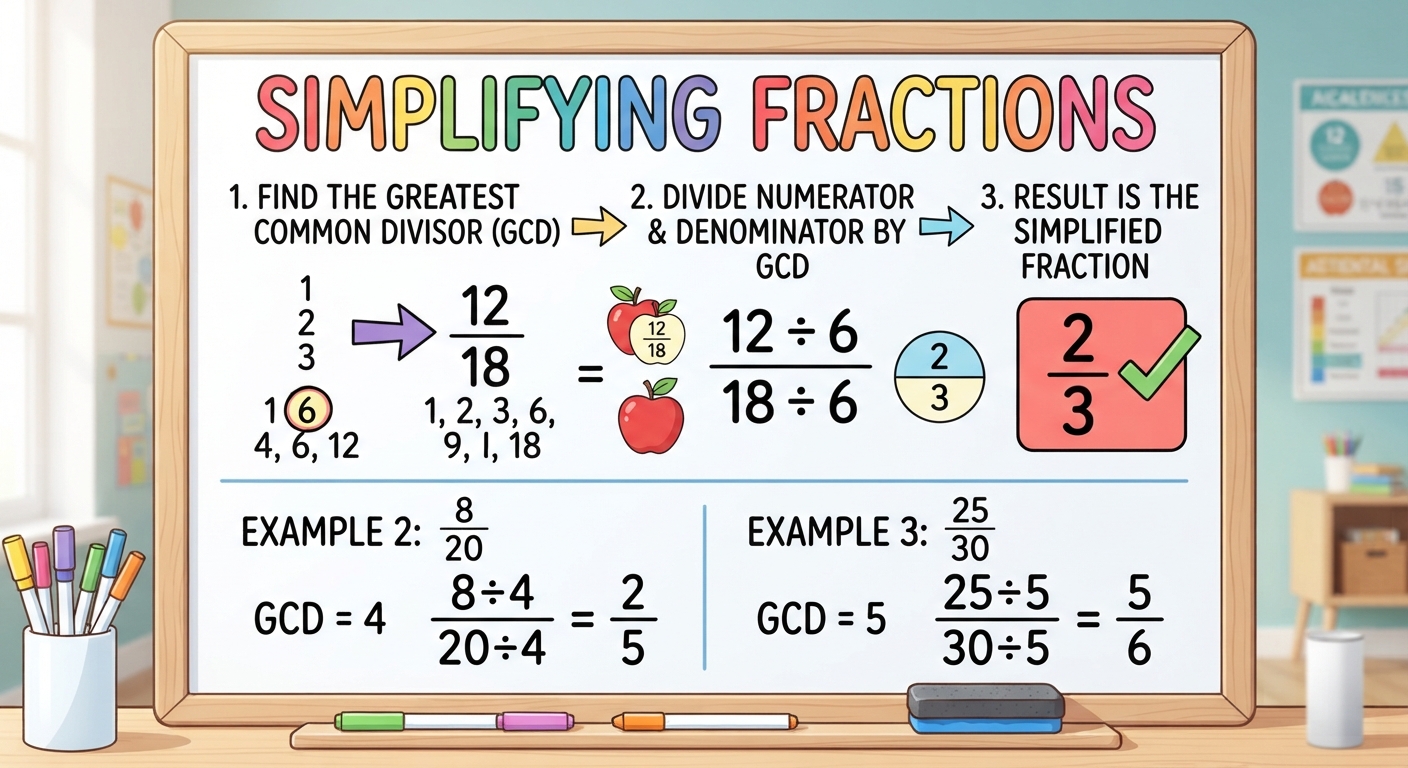
How To Simplify Fractions In Three Steps
The short version
- To simplify a fraction, find the greatest common factor (GCF) of the numerator and denominator, then divide both by it. 36/48 has a GCF of 12, and 36 ÷ 12 = 3 with 48 ÷ 12 = 4, so it becomes 3/4.
- If the GCF is hard to spot, divide by any common factor you see (2, 3, 5) and repeat until nothing divides both numbers.
- A fraction is in simplest form when the only number that divides both the top and the bottom is 1.
- Simplifying never changes the value. 36/48 and 3/4 are the same amount written two ways.
Here’s how to simplify fractions in one sentence: find the greatest common factor of the numerator and the denominator, then divide both of them by that number. What’s left is the same fraction in simplest form. If you can’t find the GCF right away, divide by any factor they share and keep going until no number except 1 divides both.
Simplifying is also called reducing. A teacher who asks how to simplify fractions and a worksheet that says “reduce to lowest terms” want the same thing: smaller numbers, same value.
What simplifying a fraction actually means
A fraction is a division problem in disguise. 36/48 means 36 ÷ 48, and so does 3/4. You can check that on a calculator: both give 0.75. Simplifying finds the version with the smallest whole numbers that still gives the same answer.
The reason it works is the identity rule. Dividing the top and bottom by the same number is the same as dividing the whole fraction by 1, and dividing by 1 changes nothing.
This is why teachers ask for simplest form on almost every fraction answer. 3/4 is easier to picture, easier to compare, and easier to use in the next step of a problem than 36/48.
How to simplify fractions with the greatest common factor
This is the method that gets you to simplest form in one move. Take 36/48.
Step 1. List the factors of each number.
Factors of 36: 1, 2, 3, 4, 6, 9, 12, 18, 36
Factors of 48: 1, 2, 3, 4, 6, 8, 12, 16, 24, 48
Step 2. Find the biggest number on both lists. Both lists contain 1, 2, 3, 4, 6 and 12. The largest is 12, so the GCF is 12.
Step 3. Divide the top and the bottom by the GCF.
36 ÷ 12 = 3
48 ÷ 12 = 4
So 36/48 = 3/4.
Step 4. Check. Do 3 and 4 share any factor besides 1? No. Done.
Here’s the same method on 45/60. Factors of 45 are 1, 3, 5, 9, 15, 45. Factors of 60 are 1, 2, 3, 4, 5, 6, 10, 12, 15, 20, 30, 60. The GCF is 15.
45 ÷ 15 = 3
60 ÷ 15 = 4
So 45/60 = 3/4.
Two other ways that get the same answer
Divide by small factors until you can’t
Most explanations of how to simplify fractions stop at the GCF, which is a problem for younger students who can’t spot it yet. They don’t need it. Divide by any common factor you recognize, then look again. More steps, same destination.
36/48 again, this time the slow way:
Both are even, so divide by 2: 18/24
Both still even, divide by 2 again: 9/12
Both are multiples of 3, divide by 3: 3/4
Nothing divides 3 and 4 except 1, so stop.
Start with 2 whenever both numbers are even. Then try 3, then 5. Those three cover most textbook fractions.
Prime factorization for ugly numbers
When the numbers get big, break both into primes and cross off what matches. Take 84/126.
84 = 2 × 2 × 3 × 7
126 = 2 × 3 × 3 × 7
Both lists share one 2, one 3 and one 7. That’s 2 × 3 × 7 = 42, the GCF.
84 ÷ 42 = 2
126 ÷ 42 = 3
So 84/126 = 2/3.
The same thing works by crossing off matched primes: what’s left on top is 2, what’s left on the bottom is 3.
How to tell a fraction is already in simplest form
A fraction is done when the numerator and denominator share no factor except 1. Two quick checks catch most cases before you waste time hunting.
First, if the numerator is a prime number and it doesn’t divide the denominator, you’re finished. 13/40 is done, because 13 is prime and 40 isn’t a multiple of 13. Second, if one number is odd and the other is even, 2 is out, so you only have to test odd factors.
Divisibility rules do the rest of the work.
| Divides by | Test | Example |
|---|---|---|
| 2 | Last digit is even | 54 ends in 4, so yes |
| 3 | Digits add to a multiple of 3 | 54 gives 5 + 4 = 9, so yes |
| 4 | Last two digits form a multiple of 4 | 216 ends in 16, so yes |
| 5 | Last digit is 0 or 5 | 85 ends in 5, so yes |
| 6 | Passes the 2 test and the 3 test | 54 passes both, so yes |
| 9 | Digits add to a multiple of 9 | 72 gives 7 + 2 = 9, so yes |
Try 15/28. The 15 is odd, so 2 is out. Digits of 28 add to 10, so 3 is out. 28 doesn’t end in 0 or 5, so 5 is out. Nothing is left to try, and 15/28 is already in simplest form.
Improper fractions and mixed numbers
An improper fraction (top bigger than bottom) simplifies the same way. Nothing special happens.
Take 42/28. The GCF of 42 and 28 is 14.
42 ÷ 14 = 3
28 ÷ 14 = 2
So 42/28 = 3/2, which is 1 1/2 as a mixed number.
For a mixed number, leave the whole number alone and simplify only the fraction part. In 4 18/24, the GCF of 18 and 24 is 6, so 18/24 becomes 3/4 and the answer is 4 3/4. The 4 never enters the division.
Teachers differ on whether the final answer should be 3/2 or 1 1/2. Both are simplified. Check what the assignment asks for.
Common mistakes when simplifying fractions
Subtracting instead of dividing. Seeing that 8 and 12 both relate to 4 and writing 4/8 is the classic error. Simplifying divides. 8 ÷ 4 = 2 and 12 ÷ 4 = 3, so 8/12 = 2/3.
Dividing only the top or only the bottom. 10/15 becomes 2/15 in a lot of homework. Both numbers have to be divided by the same thing or the value changes.
Stopping too early. 24/36 divided by 2 gives 12/18, which still has more to give. Always ask whether the new pair still shares a factor.
Canceling digits instead of factors. Crossing the 6 in 16/64 to get 1/4 happens to be right, which is exactly what makes it dangerous. Try it on 16/65 and you get 1/5, but 16/65 is already in simplest form. Cancel factors, never digits.
Thinking the fraction got smaller. Kids hear “reduce” and picture less pie. 36/48 and 3/4 are the same amount. Only the numbers shrank.
Practice problems
- Simplify 10/15.
- Simplify 24/36.
- Simplify 45/60.
- Which of these is already in simplest form: 9/21, 14/35, or 13/40?
- Simplify 84/144.
- Simplify 56/21 and write it as a mixed number.
- Simplify the mixed number 3 27/45.
- A carton holds 24 strawberries and 18 of them are ripe. What fraction is ripe, in simplest form?
Answers
1. 2/3. The GCF of 10 and 15 is 5, and 10 ÷ 5 = 2 with 15 ÷ 5 = 3.
2. 2/3. The GCF of 24 and 36 is 12, and 24 ÷ 12 = 2 with 36 ÷ 12 = 3.
3. 3/4. The GCF is 15, and 45 ÷ 15 = 3 with 60 ÷ 15 = 4.
4. 13/40. The other two simplify: 9/21 = 3/7 (divide by 3) and 14/35 = 2/5 (divide by 7). 13 is prime and 40 is not a multiple of 13.
5. 7/12. Primes give 84 = 2 × 2 × 3 × 7 and 144 = 2 × 2 × 2 × 2 × 3 × 3, so the shared part is 2 × 2 × 3 = 12. Then 84 ÷ 12 = 7 and 144 ÷ 12 = 12.
6. 8/3, which is 2 2/3. The GCF of 56 and 21 is 7, and 56 ÷ 7 = 8 with 21 ÷ 7 = 3. Then 3 goes into 8 twice with 2 left over.
7. 3 3/5. The GCF of 27 and 45 is 9, and 27 ÷ 9 = 3 with 45 ÷ 9 = 5. The whole number 3 stays put.
8. 3/4. The fraction is 18/24, the GCF is 6, and 18 ÷ 6 = 3 with 24 ÷ 6 = 4.
What it means if your child is stuck on this
A kid who keeps asking how to simplify fractions after a week of practice usually isn’t confused about fractions at all. Simplifying is a multiplication problem wearing a fraction costume. They can’t see that 42 and 56 both sit in the seven times table, so the common factor stays invisible no matter how long they stare.
That’s why the fix is often lower than the assignment. Solid times tables through 12, plus the divisibility rules above, turn simplifying into a ten second job. Without them, every fraction becomes a guessing game, and guessing games are where math anxiety starts. Math Anxiety In Children: What It Looks Like And What Helps covers what that looks like at the kitchen table.
Fractions are also the skill that decides how algebra goes three or four years later. We wrote about that pattern in Struggling With Algebra? The Real Problem Is Usually Fourth Grade Fractions. If you want to know where simplifying is supposed to land by grade, Math Skills By Grade Level: What Your Child Should Know lays it out.
Frequently asked questions
What does it mean to simplify a fraction?
It means rewriting the fraction with the smallest whole numbers possible without changing its value. You divide the numerator and denominator by their greatest common factor. 20/24 simplifies to 5/6, and both represent the same amount.
How do you simplify fractions step by step?
Find the GCF of the top and bottom numbers, divide both by it, then check that the new pair shares no factor except 1. If the GCF is hard to find, divide by 2, 3 or 5 repeatedly until nothing divides both.
What is the simplest form of a fraction?
A fraction is in simplest form (also called lowest terms) when the numerator and denominator have no common factor other than 1. 7/12 is in simplest form. 8/12 is not, because both divide by 4.
Can you simplify a fraction with a prime numerator?
Only if the denominator is a multiple of that prime. 7/21 simplifies to 1/3 because 21 = 7 × 3. But 7/20 is already in simplest form, since 20 isn’t a multiple of 7.
Do you have to simplify every fraction answer?
Most teachers and most tests require it, and answer keys are usually written in simplest form. Even when it isn’t required, simplifying first makes the rest of the problem easier.
Find the actual gap
If simplifying keeps going wrong, the useful question isn’t which fraction rule got missed. It’s which skill underneath is shaky. Math Anon opens with a short adaptive assessment that changes difficulty as your child answers, then sends you a written report naming the exact skills that need work, whether that’s multiplication facts, division, or fractions themselves. Start the assessment to see the list.
From there it’s roughly 20 minutes a day of practice built around those gaps, with a progress report each week showing what improved. The assessment runs $49 and the whole amount comes back as credit on your first month. See our pricing page for the rest, or read Mind The Gap: A Parent’s Guide To Math Assessment For Kids first.





