
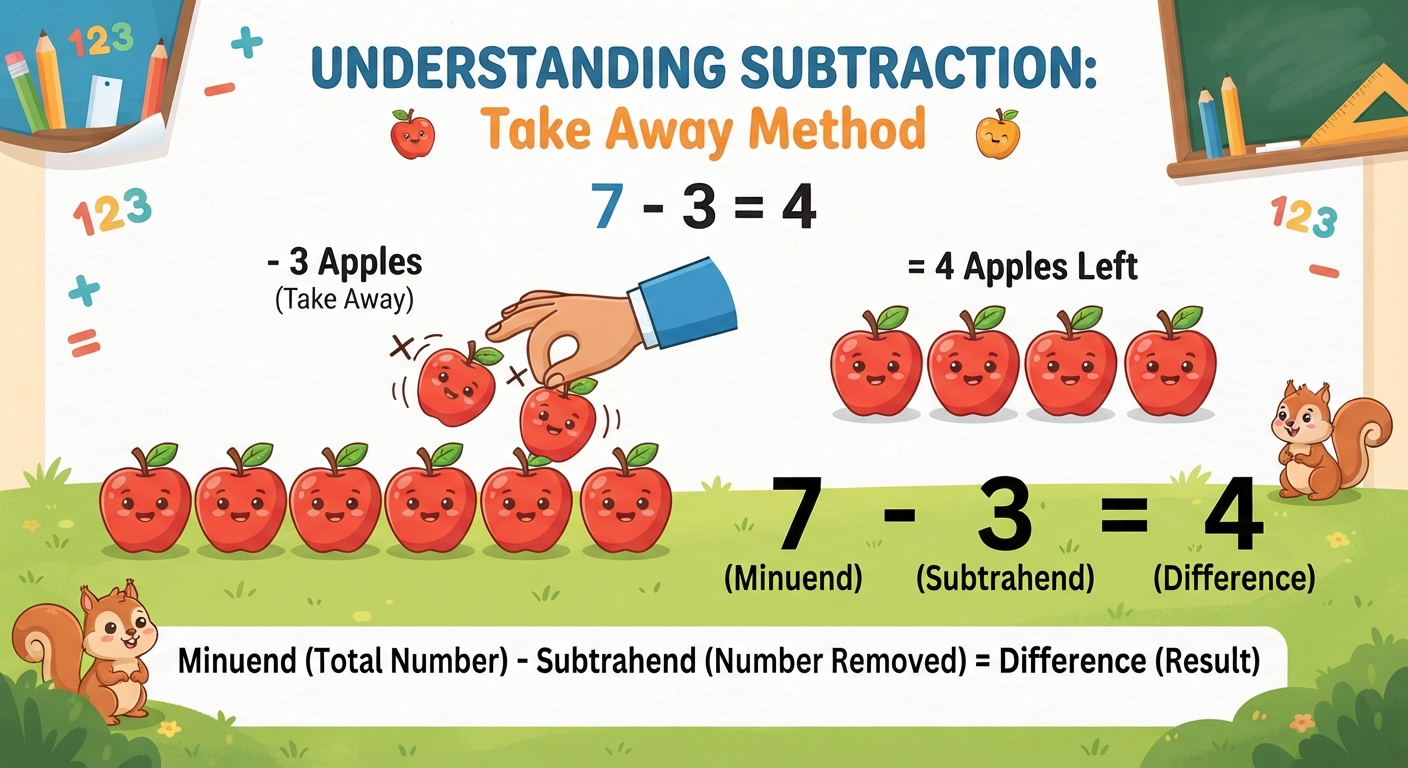
What Is Subtraction? A Parent’s Guide
The short version
- Subtraction is taking one number away from another. The answer is called the difference.
- It has three jobs in school math: take away, compare two amounts, and find a missing part.
- Subtraction undoes addition. If 7 + 5 = 12, then 12 – 5 = 7 and 12 – 7 = 5. That’s a fact family.
- Order matters. 9 – 4 and 4 – 9 are not the same, which is the difference between subtraction and addition.
- Kids who stall on subtraction almost always have a place value or number bond gap underneath, not a subtraction gap.
Subtraction is the operation that finds how much is left, or how much bigger one number is than another. Write it with a minus sign: 12 – 5 = 7. Along with addition, multiplication and division, it’s one of the four operations everything else in math gets built on.
Most kids meet subtraction in kindergarten as “take away” and stay there for years. That’s the problem. Subtraction actually answers several different kinds of questions, and a student who only knows the take away version freezes the first time a word problem asks “how many more.”
The three things subtraction means
Taking away. You had 10 grapes and ate 3. 10 – 3 = 7 grapes left. This is the version every kid learns first, and it works when something physically leaves.
Comparing. Maya is 15 and her brother is 10. How much older is she? Nothing is being removed. You’re measuring the gap: 15 – 10 = 5 years. Word problems signal this with “how many more,” “how much taller,” or “what’s the difference.”
Finding a missing part. A puzzle has 60 pieces and 42 are in place. How many are left in the box? 60 – 42 = 18. You know the whole and one part, so subtraction gives you the other part.
All three use the same arithmetic. What changes is the story. When a kid can do 15 – 10 on a worksheet but blanks on the brother question, the arithmetic isn’t the issue. The meaning is.
Subtraction vocabulary
Teachers use these words on tests, so it helps to know them even if they sound stuffy.
| Word | What it means | In 15 – 6 = 9 |
|---|---|---|
| Minuend | The number you start with | 15 |
| Subtrahend | The number being taken away | 6 |
| Difference | The answer | 9 |
| Minus sign | The symbol for the operation | – |
Word problems hide subtraction behind a lot of phrases: minus, less, fewer than, take away, decreased by, how many more, how many are left, and the difference between. Teach your child to hunt for those instead of guessing.
Subtraction on a number line
A number line turns subtraction into movement, which helps kids who lose track of the counting.
For 13 – 5, start at 13 and hop left 5 times: 12, 11, 10, 9, 8. The answer is 8.
For the comparison version, put both numbers on the line and measure the gap. For 13 – 5 you can jump from 5 up to 13 and count the distance, which is also 8. Same answer, opposite direction. Kids who see both are far more likely to recognize subtraction when nothing is being taken away.
The number line also makes negative results obvious. 4 – 9 means starting at 4 and going left 9, which lands on -5. That’s why order matters in subtraction and doesn’t in addition.
Fact families: subtraction is addition backwards
Three numbers that belong together make four facts. Take 6, 8 and 14:
6 + 8 = 14
8 + 6 = 14
14 – 6 = 8
14 – 8 = 6
A student who knows 6 + 8 already knows 14 – 8. They just have to see it. This is why the fastest fix for slow subtraction is usually drilling addition facts to automatic, then pointing out the connection.
It also gives kids a checking habit that costs nothing. After answering 52 – 17 = 35, add it back: 35 + 17 = 52. If it doesn’t match, the answer is wrong.
Regrouping, in one example
Regrouping, sometimes called borrowing, comes up when a digit on top is smaller than the digit under it.
Take 74 – 28.
Ones column: 4 – 8 won’t work with whole numbers.
So trade one ten from the 7 tens. The 7 becomes 6, and the 4 becomes 14.
Now 14 – 8 = 6.
Tens column: 6 – 2 = 4.
Answer: 46.
Check it: 46 + 28 = 74. Correct.
Nothing was invented or destroyed in that trade. 74 is 7 tens and 4 ones, and it’s also 6 tens and 14 ones. Kids who see regrouping as a magic rule about crossing out numbers will misapply it forever. Kids who see it as re-splitting the same amount stop making the error.
Common mistakes
Subtracting the smaller digit from the bigger one, column by column. A kid faced with 74 – 28 writes 54, because they did 8 – 4 in the ones column. It’s the single most common subtraction error in elementary school and it always traces back to shaky place value.
Forgetting to reduce the digit they borrowed from. They turn 4 into 14 but leave the 7 as a 7, so the answer comes out 56 instead of 46.
Getting lost in a string of zeros. 300 – 147 stops kids cold because there’s nothing next door to borrow from. Trading 300 for 2 hundreds, 9 tens and 10 ones fixes it.
Assuming subtraction can be flipped. 9 – 4 is 5, but 4 – 9 is -5. Addition lets you swap the numbers. Subtraction does not.
Reaching for subtraction on any word problem with two numbers. Kids who scan for a keyword instead of reading the situation will subtract when the problem wanted addition.
Practice problems
These run from single digits up to a word problem with two steps.
1. 9 – 4
2. 52 – 30
3. 13 – ___ = 8
4. 74 – 28
5. How much bigger is 27 than 12?
6. 300 – 147
7. 1,000 – 486
8. Leo has 45 stickers. He gives 17 to his sister, then his aunt gives him 8 more. How many does he have?
Answers
1. 5.
2. 22. No regrouping needed: 2 – 0 = 2 and 5 – 3 = 2.
3. 5, because 8 + 5 = 13.
4. 46. Trade a ten: 14 – 8 = 6, then 6 – 2 = 4. Check: 46 + 28 = 74.
5. 27 – 12 = 15.
6. 153. Rewrite 300 as 2 hundreds, 9 tens, 10 ones: 10 – 7 = 3, 9 – 4 = 5, 2 – 1 = 1. Check: 153 + 147 = 300.
7. 514. Check: 514 + 486 = 1,000.
8. 45 – 17 = 28, then 28 + 8 = 36 stickers.
What it means if your kid is stuck on subtraction
Subtraction trouble is almost never about subtraction. It’s a symptom, and the cause is usually one of two things sitting underneath.
The first is addition facts that aren’t automatic. If your child counts on fingers to get 8 + 6, every subtraction problem turns into a slow rebuild, and multi digit problems fall apart because working memory is already full. The second is place value. A student who can’t tell you that 74 means 7 tens and 4 ones has no reason to believe the borrowing rule, so they follow it from memory and it breaks under pressure. Both are fixable in weeks, not years, with short daily sessions rather than long weekend marathons, which is the whole argument for 20 minutes a day over a 90 minute tutoring block.
It’s worth checking whether the gap is wider than one topic. The skills expected at each grade level give you a straight comparison, and the warning signs by grade tell you when a wobble is turning into a pattern. If your child gets upset before the pencil even moves, look at math anxiety too, because a stressed kid tests well below what they actually know.
Frequently asked questions
What is the answer in subtraction called?
The difference. In 15 – 6 = 9, the 9 is the difference, 15 is the minuend and 6 is the subtrahend.
What grade do kids learn subtraction?
Kindergarten starts with take away up to 10. First grade goes to 20 and adds word problems. Second grade brings in regrouping within 100, and third and fourth grade extend it to larger numbers, with decimals and fractions arriving later.
Why does my child subtract the wrong way in a column?
They’re subtracting the smaller digit from the larger one in each column because that always “works” without regrouping. The fix is place value practice with blocks or drawn tens, not more worksheets of the same kind.
Is subtraction the opposite of addition?
Yes. Each undoes the other, which is why every subtraction problem can be checked by adding the answer back to the number you took away.
Can you subtract a bigger number from a smaller one?
Yes, and the result is negative. 4 – 9 = -5. Most students meet this properly in sixth grade, though a number line makes it sensible much earlier.
What does the difference between two numbers mean?
It’s the gap between them, found by subtracting the smaller from the larger. The difference between 27 and 12 is 15.
Find the actual gap
If subtraction is where the homework falls apart, the real break is usually one or two skills earlier, and guessing which one costs months. Math Anon opens with a short adaptive assessment that shifts with your child’s answers until it pins down the exact missing pieces, then hands you a written report saying what they are in plain language.
What follows is about 20 minutes a day of practice built around those specific gaps, plus a weekly progress report so you can watch them close. The assessment costs $49, and we credit every dollar of it back on your first month. Start the assessment, or look over pricing first.





