
2D Shapes: Names, Properties And Formulas
The short version
- 2D shapes are flat shapes with only two dimensions, length and width. They have area and perimeter but no volume.
- Most 2D shapes kids learn are polygons: closed shapes made of straight sides, named by how many sides they have (triangle 3, quadrilateral 4, pentagon 5, hexagon 6, octagon 8).
- Circles, ovals and semicircles are 2D shapes too, but they aren’t polygons because they have curved edges.
- The faces of 3D shapes are 2D shapes. A cube’s faces are squares, and a cylinder’s ends are circles.
- The angles inside any polygon add up to (number of sides – 2) × 180°.
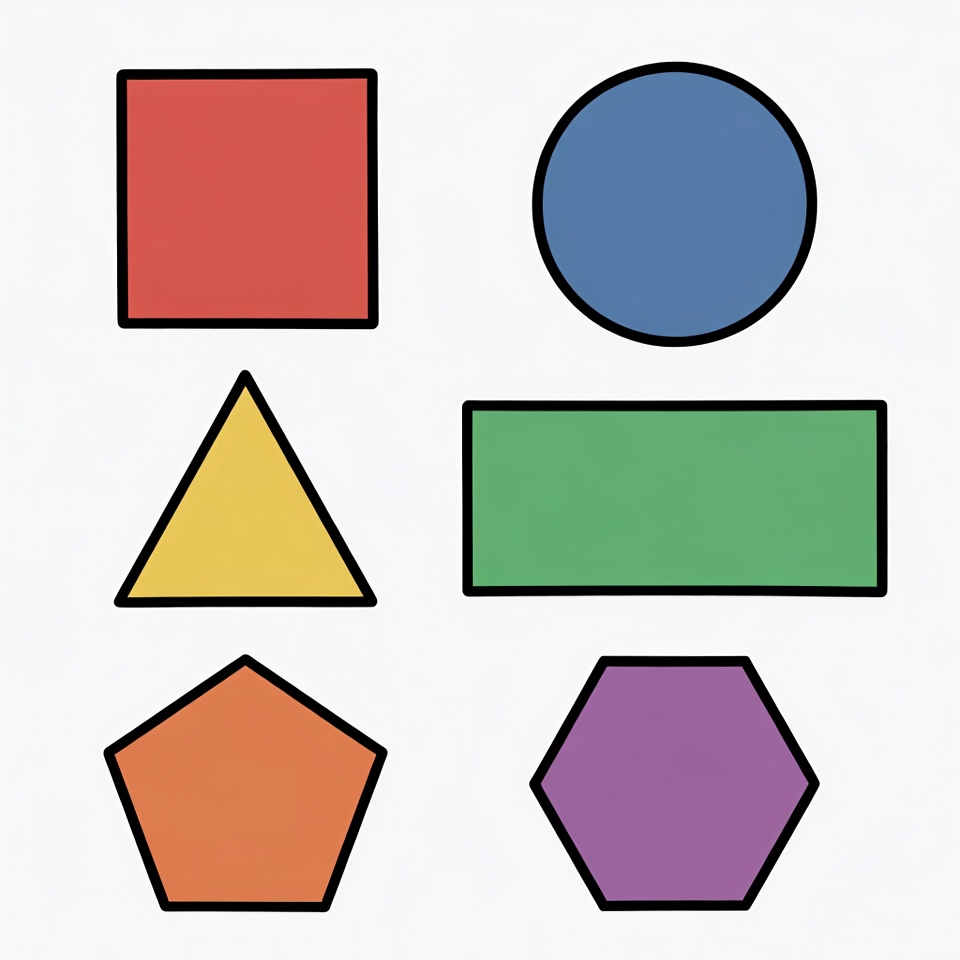
2D shapes are flat, closed figures that have length and width but no thickness. Squares, rectangles, triangles, circles, pentagons and hexagons are all 2D shapes. You can draw any of them on paper, and you can measure their perimeter (the distance around) and their area (the space inside).
That’s the definition. What kids actually get tested on is naming shapes by their sides and angles, sorting them into families, and finding perimeter and area. This guide covers all of it, with a full names chart, worked examples, the mistakes that trip kids up, and practice problems with answers.
What makes a shape 2D?
“2D” means two-dimensional. A 2D shape lives entirely on a flat surface. It has two measurements: how long and how wide. A 3D shape adds a third, depth or height, which is why you can hold a cube but only draw a square.
A few words that come up over and over with 2D shapes:
- Side (or edge): a straight line segment that forms part of the shape.
- Vertex: a corner, where two sides meet. The plural is vertices.
- Angle: the amount of turn between two sides at a vertex, measured in degrees.
- Closed: the outline connects all the way around with no gaps. An open outline, like a letter C drawn with straight lines, isn’t a polygon.
A shape is regular when all its sides are the same length and all its angles are the same size. A stop sign is a regular octagon. A shape is irregular when the sides or angles differ. A rectangle that isn’t a square is an irregular quadrilateral.
2D shapes names chart
Polygons are named by their number of sides. The number of sides always equals the number of vertices.
| Shape | Sides | Vertices | Interior angles add to |
|---|---|---|---|
| Triangle | 3 | 3 | 180° |
| Quadrilateral | 4 | 4 | 360° |
| Pentagon | 5 | 5 | 540° |
| Hexagon | 6 | 6 | 720° |
| Heptagon | 7 | 7 | 900° |
| Octagon | 8 | 8 | 1,080° |
| Nonagon | 9 | 9 | 1,260° |
| Decagon | 10 | 10 | 1,440° |
Curved 2D shapes
A circle is every point the same distance (the radius) from a center point. An oval or ellipse is a stretched circle. A semicircle is half a circle, with one curved edge and one straight edge. None of these are polygons, since polygons need all straight sides.
The quadrilateral family
Four-sided shapes cause the most confusion, because one shape can have several correct names. Think of it like a family tree: a square is a special rectangle, and a rectangle is a special parallelogram.
| Shape | What makes it that shape |
|---|---|
| Parallelogram | Two pairs of parallel sides. Opposite sides are equal. |
| Rectangle | A parallelogram with four right angles. |
| Rhombus | A parallelogram with four equal sides. |
| Square | Four equal sides and four right angles. It’s a rectangle and a rhombus at the same time. |
| Trapezoid | At least one pair of parallel sides. (Some textbooks say exactly one pair, so check which definition your kid’s class uses.) |
| Kite | Two pairs of equal sides that are next to each other, not opposite. |
So is every square a rectangle? Yes. Is every rectangle a square? No, because a rectangle’s sides don’t all have to be equal.
Perimeter and area formulas for 2D shapes
Because 2D shapes are flat, the two things you can measure are the distance around them and the space they cover. Perimeter is in plain units (cm, inches). Area is in square units (cm², square inches).
| Shape | Perimeter | Area |
|---|---|---|
| Square (side s) | 4 × s | s × s |
| Rectangle (length l, width w) | 2 × (l + w) | l × w |
| Triangle (base b, height h) | add the three sides | b × h ÷ 2 |
| Parallelogram (base b, height h) | add the four sides | b × h |
| Circle (radius r) | 2 × π × r (called circumference) | π × r × r |
Worked examples
Rectangle. A rectangle is 8 cm long and 5 cm wide.
Perimeter = 2 × (8 + 5) = 2 × 13 = 26 cm
Area = 8 × 5 = 40 cm²
Triangle. A triangle has a base of 10 in and a height of 6 in.
Area = 10 × 6 ÷ 2 = 60 ÷ 2 = 30 square inches
Circle. A circle has a radius of 3 m.
Circumference = 2 × π × 3 = 6π, about 18.85 m
Area = π × 3 × 3 = 9π, about 28.27 m²
Angles in a regular hexagon. A hexagon has 6 sides.
Angle total = (6 – 2) × 180° = 4 × 180° = 720°
In a regular hexagon all six angles match, so each one is 720° ÷ 6 = 120°.
2D shapes vs 3D shapes
| 2D shapes | 3D shapes | |
|---|---|---|
| Dimensions | Length and width | Length, width and height |
| Examples | Square, circle, triangle | Cube, sphere, cone, pyramid |
| You can measure | Perimeter, area | Surface area, volume |
| Parts | Sides, vertices, angles | Faces, edges, vertices |
The two connect directly: every flat face on a 3D shape is a 2D shape. A square pyramid has one square face and four triangle faces. If you unfold a box flat, the pattern you get (called a net) is made entirely of rectangles.
Common mistakes with 2D shapes
- Calling a tilted square a “diamond.” Turning a shape doesn’t change what it is. A square rotated 45° is still a square. (It’s also a rhombus, which is probably what “diamond” means.)
- Thinking a circle is a polygon. Polygons have only straight sides, so a circle doesn’t count.
- Only recognizing “textbook” triangles. Kids who’ve mostly seen triangles sitting flat on one side sometimes won’t call a long, skinny or upside-down triangle a triangle. Any closed shape with three straight sides is one.
- Mixing up area and perimeter. A kid who adds the sides when asked for area, or multiplies when asked for perimeter, needs the meaning, not the formula. Perimeter is a fence. Area is the grass inside it.
- Using the diameter as the radius. If a circle’s diameter is 10, the radius is 5. Plugging in 10 gives an area four times too big.
- Forgetting square units. Area answers need cm², ft² and so on.
Practice problems
- How many sides does an octagon have?
- Find the perimeter of a square with sides of 7 cm.
- Find the area of a rectangle that’s 9 ft by 4 ft.
- Find the area of a triangle with a base of 12 in and a height of 5 in.
- What do the interior angles of a pentagon add up to?
- How big is each angle in a regular octagon?
- A circle has a diameter of 10 cm. Find its area, using 3.14 for π.
- True or false: every rectangle is a square.
Answers
- 8 sides.
- 4 × 7 = 28 cm.
- 9 × 4 = 36 square feet.
- 12 × 5 ÷ 2 = 30 square inches.
- (5 – 2) × 180° = 540°.
- (8 – 2) × 180° = 1,080°, and 1,080° ÷ 8 = 135°.
- Radius = 10 ÷ 2 = 5 cm. Area = 3.14 × 5 × 5 = 78.5 cm².
- False. Every square is a rectangle, but a rectangle only needs four right angles, not four equal sides.
What it means if your kid is stuck on 2D shapes
Naming shapes is usually fine by second grade. The trouble tends to start when shapes meet numbers. If your child can name a hexagon but can’t find its perimeter, the gap is often multiplication facts or adding multi-digit numbers. If area problems go wrong, check whether they understand what “square units” means before drilling formulas. Our breakdown of math skills by grade level shows when each of these normally clicks.
Angle work is the other common snag. Finding a missing angle in a triangle or a regular polygon uses the same subtract-from-a-total thinking as supplementary angles. And if geometry is just one of several topics where your kid is slipping, these grade-level signs can help you figure out whether it’s a pattern.
Frequently asked questions
What are 2D shapes called?
Their general name is plane figures or plane shapes. The ones with straight sides are called polygons, and each polygon has its own name based on its number of sides.
Is a circle a 2D shape?
Yes. A circle is flat and has length and width, so it’s 2D. It isn’t a polygon, though, because it has no straight sides and no vertices.
How many 2D shapes are there?
Infinitely many, since you can make a polygon with any number of sides from 3 up. Kids usually learn names up to the decagon (10 sides), plus circles, ovals and the quadrilateral family.
What’s the difference between 2D and 3D shapes?
2D shapes are flat, with only length and width. 3D shapes are solid, with length, width and height. The faces of a 3D shape are 2D shapes.
Is a heart shape a 2D shape?
Yes. A heart drawn on paper is flat and closed, so it’s 2D. It isn’t a polygon, because it has curved edges.
What 2D shapes should kindergarteners know?
Kindergarten usually covers circles, squares, triangles, rectangles and hexagons, and kids learn to spot them in different sizes and positions.
Find the actual gap
If shape homework keeps going wrong, the missing piece is often something earlier, like multiplication facts behind area or subtraction behind missing angles. Math Anon’s short adaptive assessment tracks down those specific skills and gives you a written report of what’s solid and what isn’t.
Then your kid does about 20 minutes a day of practice aimed at exactly those gaps, and you get a progress report each week. The assessment costs $49, and that $49 is credited in full toward the first month. Start the assessment or check pricing first.





