
Combining Like Terms: Rules, Examples And Practice
The short version
- Like terms have the exact same variable part: same letters raised to the same powers. 4x and -9x are like terms. 4x and 4x² aren’t.
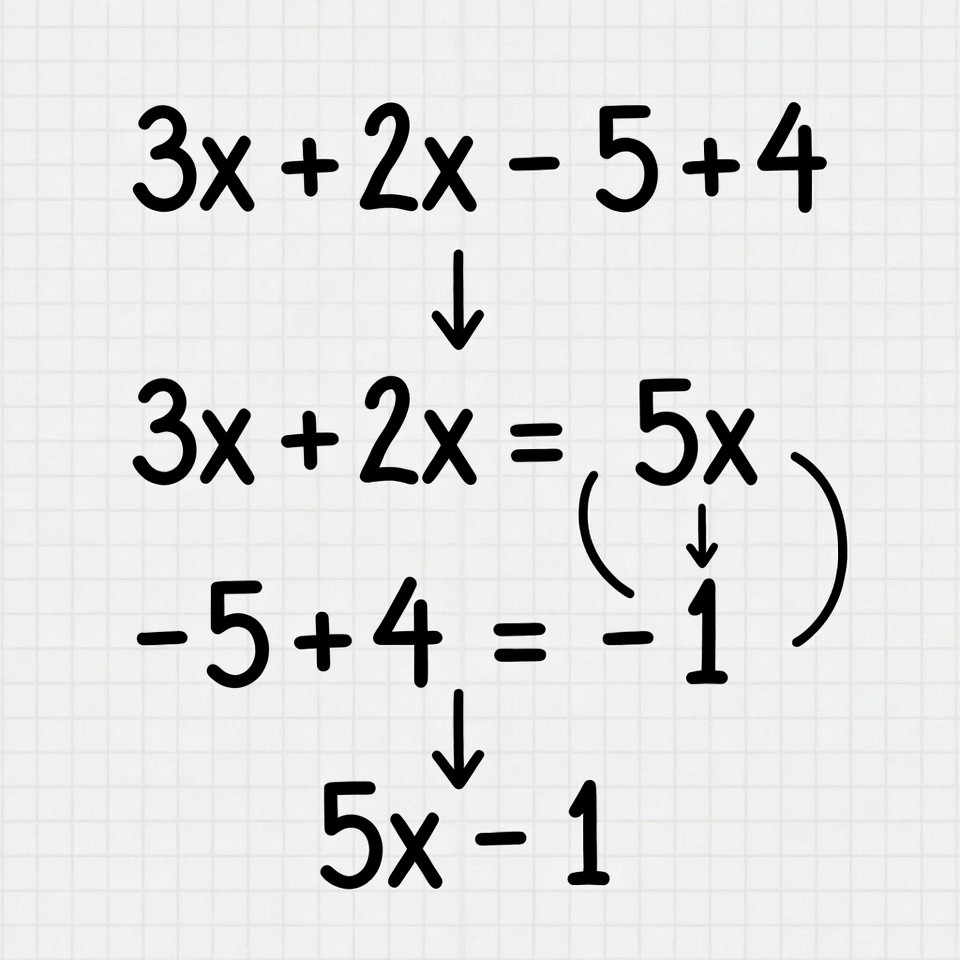
- To combine like terms, add or subtract the numbers in front (the coefficients) and keep the variable part unchanged: 3x + 5x = 8x.
- The sign in front of a term belongs to that term. In 6y – 2y + 4, the 2y is really -2y.
- If there are parentheses, use the distributive property first, then combine.
- Exponents never change when you combine. 3x + 2x is 5x, not 5x².
Combining like terms means adding or subtracting terms that have the same variables with the same exponents, so a long expression becomes a shorter one that’s worth exactly the same. You add the coefficients and leave the variable part alone: 4x + 7 + 2x – 3 becomes 6x + 4.
It’s usually the first real skill in pre-algebra, and it shows up inside almost every equation your kid will solve later. Below are the rules, a step-by-step method, worked examples that include negatives and parentheses, the mistakes we see most, and practice problems with an answer key.
What makes terms “like terms”
A term is one chunk of an expression, separated from the others by + or – signs. In 5x² – 3x + 8, there are three terms: 5x², -3x, and 8.
Each term with a variable has a coefficient (the number in front) and a variable part (the letters and their exponents). A term with no variable is a constant.
Two terms are like terms when their variable parts match exactly. The coefficients can be anything.
| Pair | Like terms? | Reason |
|---|---|---|
| 7x and -2x | Yes | Both are x to the first power |
| 3a² and a² | Yes | Both are a squared |
| 9 and -4 | Yes | Both are constants |
| 5xy and 2yx | Yes | xy and yx are the same product |
| 4x and 4y | No | Different variables |
| 6m and 6m² | No | Different exponents |
A useful picture: think of x as “boxes” and x² as “crates.” Three boxes plus two boxes is five boxes. Three boxes plus two crates is just three boxes and two crates. You can’t merge them into one pile with one label.
How to combine like terms, step by step
- Clear parentheses with the distributive property, if there are any.
- Attach each sign to the term after it. Treat 8 – 3x as 8 + (-3x).
- Group the like terms. Underline x terms once, x² terms twice, circle constants. Or rewrite them side by side.
- Add the coefficients in each group. Remember that x by itself has a coefficient of 1.
- Write the result, usually with the highest exponent first and the constant last.
Combining like terms: worked examples
Example 1: the basics
Simplify 4x + 7 + 2x – 3.
x terms: 4x + 2x = 6x
Constants: 7 – 3 = 4
Answer: 6x + 4
Example 2: two variables and negatives
Simplify 5a – 2b – a + 6b – 8.
a terms: 5a – a = 5a – 1a = 4a
b terms: -2b + 6b = 4b
Constants: -8
Answer: 4a + 4b – 8
Notice the lone “a.” Its coefficient is 1, so 5a – a is 4a. Kids who forget the invisible 1 often write 5a here.
Example 3: squared terms
Simplify 3x² + 2x – x² + 5x – 4.
x² terms: 3x² – x² = 2x²
x terms: 2x + 5x = 7x
Constants: -4
Answer: 2x² + 7x – 4
Example 4: distribute, then combine
Simplify 3(2x + 5) – 4x.
Distribute: 3 × 2x = 6x and 3 × 5 = 15, so you have 6x + 15 – 4x
x terms: 6x – 4x = 2x
Answer: 2x + 15
Example 5: subtracting a group
Simplify 7y – (3y – 2).
The minus sign in front of the parentheses means multiply everything inside by -1.
-(3y – 2) = -3y + 2
Now: 7y – 3y + 2
Answer: 4y + 2
This one catches a lot of kids. They write 4y – 2 because they only flip the first sign.
Example 6: fractions and decimals
Simplify (1/2)x + (1/3)x.
Common denominator of 6: (3/6)x + (2/6)x = (5/6)x
And 0.5m + 1.25m = 1.75m. The rules don’t change, only the arithmetic does.
Combining like terms inside an equation
Once kids can simplify expressions, they use the same move to solve equations. Clean up each side first, then solve.
Solve 3x + 2x – 4 = 21.
Combine: 5x – 4 = 21
Add 4 to both sides: 5x = 25
Divide by 5: x = 5
Check: 3(5) + 2(5) – 4 = 15 + 10 – 4 = 21. Correct.
Only combine terms that are on the same side of the equals sign. Moving a term across the equals sign is a separate step (adding or subtracting on both sides), and mixing the two is a common source of sign errors.
Common mistakes when you combine like terms
- Adding the exponents. 3x + 2x = 5x². Wrong. Adding x’s doesn’t change the power, so it’s 5x. (Multiplying is different: x × x = x².)
- Merging x and x². 4x² + 3x doesn’t simplify. Those two are unlike terms, so the expression is already done.
- Merging a constant into a variable term. 4x + 3 isn’t 7x. It stays 4x + 3.
- Losing the sign. In 9 – 5y + 2y, the -5y and +2y combine to -3y. Kids who read it as 5y + 2y get 7y.
- Forgetting the invisible 1. x + 4x is 5x, not 4x.
- Only distributing to the first term. 2(x + 6) is 2x + 12, not 2x + 6.
Look closely and most of these trace back to older skills: adding and subtracting negatives, or multiplication, dressed up in algebra clothes.
Practice problems
- 6n + 3n
- 8 + 2k + 5 – k
- 4a + 3b – a + 2b
- -5x + 9 + 2x – 12
- 2y² + 5y – y² – 8y + 1
- 4(x – 3) + 2x
- 10m – 2(3m – 4)
- 3(2p + q) – (p – 5q)
Answers
- 9n
- k + 13 (2k – k = k, and 8 + 5 = 13)
- 3a + 5b
- -3x – 3 (-5x + 2x = -3x, and 9 – 12 = -3)
- y² – 3y + 1
- 6x – 12 (4x – 12 + 2x)
- 4m + 8 (10m – 6m + 8)
- 5p + 8q (6p + 3q – p + 5q)
What it means if your kid is stuck here
If your kid understands the idea of like terms but keeps getting wrong answers, look at the arithmetic underneath. Problems 4, 7 and 8 above are mostly tests of negative numbers. A kid who misses those but gets 1 to 3 right is probably fine on the concept and shaky on integers, which is a 6th and 7th grade skill. A kid who misses problem 6 may not have a solid grip on multiplication or the distributive property.
Fractions show up here too. Example 6 falls apart for a kid who never got comfortable with common denominators, and we explain why that one skill causes so much later trouble in Struggling With Algebra? The Real Problem Is Usually Fourth Grade Fractions. For the practice itself, short and frequent works better than one long catch-up session, which we cover in why 20 minutes a day beats a 90-minute tutoring session. If you want to know whether this is a bigger pattern, our signs by grade level can help.
Frequently asked questions
What does “combine like terms” mean?
It means adding or subtracting terms that share the same variable part so the expression gets shorter. 2x + 3x + 1 becomes 5x + 1.
Can you combine x and x²?
No. They have different exponents, so they’re unlike terms. 3x² + 4x stays as it is.
Are constants like terms?
Yes. All plain numbers are like terms with each other, so 7 and -2 combine to 5.
Are xy and yx like terms?
Yes. Multiplication can be done in any order, so xy and yx are the same. 2xy + 3yx = 5xy.
Do you combine like terms before solving an equation?
Usually, yes. Simplify each side of the equation first. It leaves fewer terms to move around and fewer chances for a sign error.
What grade learns combining like terms?
Most kids meet it in 6th or 7th grade, and it becomes a daily tool in 8th grade and Algebra 1.
Find the actual gap
A kid who struggles to combine like terms is often missing something smaller and older, like adding negative numbers or multiplying through parentheses. Math Anon begins with a short adaptive assessment that tracks down exactly which of those skills aren’t solid yet and puts it in a written report you can read.
Then your kid does about 20 minutes a day of practice built around those specific gaps, and you get a weekly report showing what’s improving. The assessment costs $49, and we credit the full amount back on your first month. Start the assessment, or check pricing first.
Related reading
- Struggling With Algebra? The Real Problem Is Usually Fourth Grade Fractions
- Why 20 Minutes A Day Beats A 90-Minute Tutoring Session
- Is My Child Behind In Math? 12 Signs By Grade Level
- Mind The Gap: A Parent’s Guide To Math Assessment For Kids
- Arithmetic Sequence Formula: Find Any Term And The Sum
- Evaluate In Math: What It Means And How To Do It





