
What Is A Right Angle? The 90 Degree Angle Explained
The short version
- A right angle is an angle that measures exactly 90 degrees. It’s the square corner you see on a sheet of paper, a door frame or a book.
- Diagrams mark right angles with a small square in the corner instead of an arc. If you see that square, the angle is 90°, even if it isn’t labeled.
- Angles smaller than 90° are acute. Angles between 90° and 180° are obtuse. Exactly 180° is a straight angle, which is two right angles side by side.
- Two lines that meet at a right angle are perpendicular. A triangle can have at most one right angle.
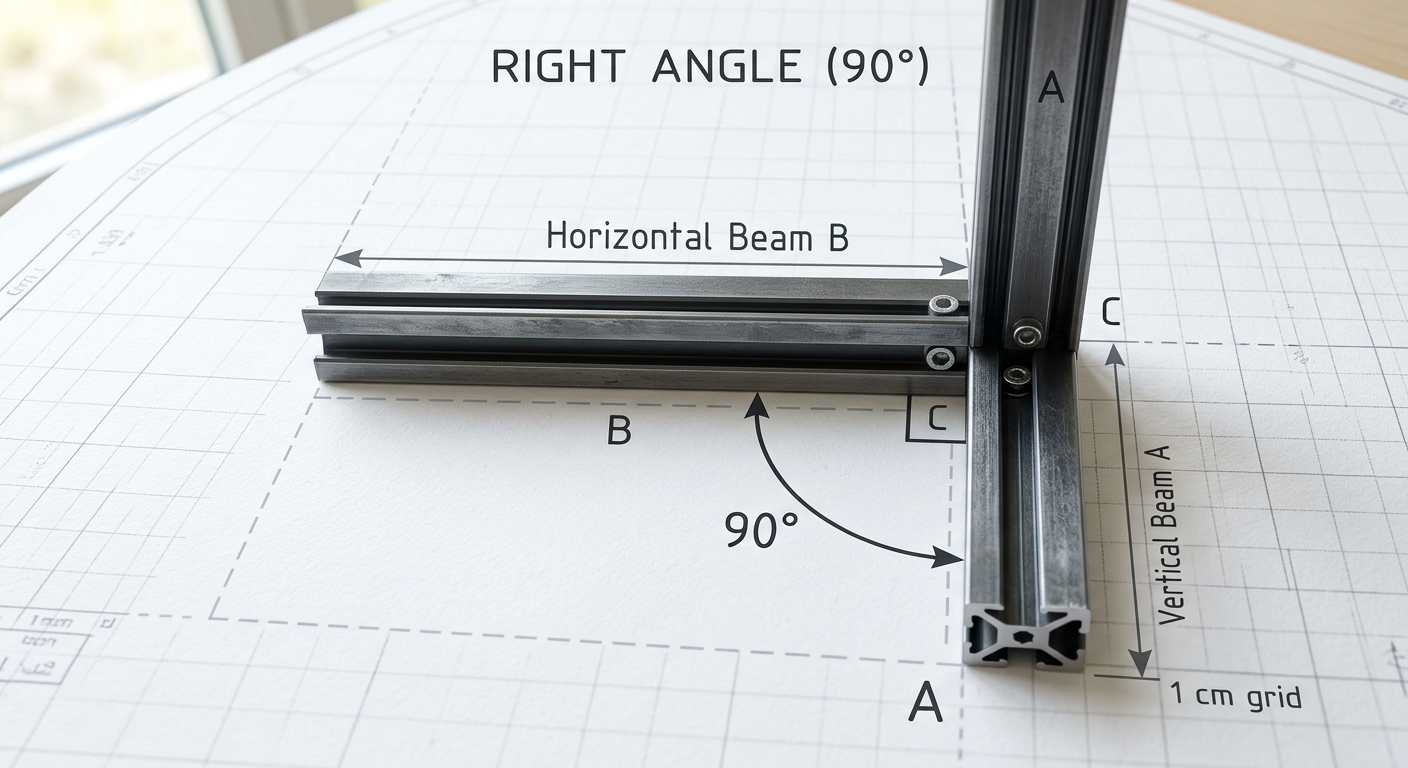
A right angle is an angle that measures exactly 90 degrees, a quarter of a full turn. You find one anywhere two straight lines meet to form a perfect square corner, like the corner of a piece of paper. In drawings, a small square in the corner tells you an angle is a right angle.
The “right” has nothing to do with direction or being correct. It comes from the Latin word rectus, meaning upright. Below we cover how to spot and check right angles, how they compare to other angles, where they show up in shapes, and the problems kids actually get asked about them, with practice and answers at the end.
What makes an angle a right angle?
An angle forms where two rays meet at a point, called the vertex. The size of the angle is how far one ray is turned from the other. A full turn all the way around is 360°. A quarter of that is:
360° ÷ 4 = 90°
So a right angle is a quarter turn. If you face forward and turn to face your left or right side, you’ve turned through a right angle.
The length of the arms doesn’t matter. A tiny corner on a sticky note and the huge corner of a football field are both right angles because the turn between the sides is the same 90°.
The right angle symbol
Most angles are marked with a small curved arc. Right angles get a small square drawn in the corner instead. On a test, that square is information: it tells you the angle is 90° even when no number is written. Kids who miss the square often get stuck on missing angle problems that are actually easy.
Right angles vs other types of angles
The 90 degree right angle is the benchmark every other angle is measured against.
| Angle type | Measure | Compared to a right angle |
|---|---|---|
| Acute | More than 0° and less than 90° | Smaller, “sharper” than a square corner |
| Right | Exactly 90° | A square corner |
| Obtuse | More than 90° and less than 180° | Wider than a square corner |
| Straight | Exactly 180° | Two right angles, forming a straight line |
| Reflex | More than 180° and less than 360° | More than two right angles |
An angle of 89° is acute and an angle of 91° is obtuse. Right angles are exact, so “close to 90” doesn’t count.
How to check for a right angle
The paper corner test
This is the one to teach younger kids. Take any sheet of printer paper or an index card and fit its corner into the angle. If both edges line up with the arms, it’s a right angle. If there’s a gap between the paper and one arm, the angle is obtuse. If the paper’s edge overlaps past an arm, the angle is acute.
Using a protractor
Put the protractor’s center mark on the vertex. Line up the zero line with one arm. Read where the other arm crosses the scale. If it reads 90, you have a right angle. Kids sometimes read the wrong row of numbers, but at 90° both scales agree, which makes right angles a good first protractor exercise.
The 3-4-5 check
Builders use this one. Measure 3 units along one side from the corner and 4 units along the other. If the distance between those two marks is exactly 5 units, the corner is a right angle. It works because 3² + 4² = 9 + 16 = 25, and 5² = 25. That’s the Pythagorean theorem, which only holds for right triangles.
Right angles in shapes
| Shape | Right angles |
|---|---|
| Square | 4 |
| Rectangle | 4 |
| Right triangle | 1 |
| Rhombus (not a square) | 0 |
| Parallelogram (not a rectangle) | 0 |
| Right trapezoid | 2 |
| Regular hexagon | 0 (each angle is 120°) |
Why a triangle can’t have two right angles
The three angles in any triangle add up to 180°. If two of them were 90°, that’s already 90 + 90 = 180°, which leaves 0° for the third angle. You can’t close a triangle with a zero degree angle, so the two sides would run parallel forever. That’s why every right triangle has exactly one right angle and two acute angles.
Perpendicular lines
When two lines cross at a right angle, they’re perpendicular, and they actually make four right angles at once. The x axis and y axis on a graph are perpendicular. So are the lines on graph paper and the edges of a window pane.
Solving problems with a right angle
Most homework involving right angles is about finding a missing angle. The key fact is that the parts of a right angle add to 90°.
Example 1: a split right angle. A right angle is split into two smaller angles. One measures 35°. Find the other.
90 – 35 = 55°
Example 2: a right triangle. A right triangle has one angle of 28°. What are the other two?
One is the right angle: 90°.
The last one: 180 – 90 – 28 = 62°.
Check: 90 + 28 + 62 = 180.
Notice that the two acute angles in a right triangle always add to 90°. Two angles that add to 90° are called complementary. Two angles that add to 180° are supplementary, which we explain in Supplementary Angles, Explained.
Example 3: clock angles. A clock face is 360°, split into 12 hours, so each hour mark is 360 ÷ 12 = 30° apart. At 3:00 the hands are 3 hours apart: 3 × 30 = 90°. That’s a right angle. The same is true at 9:00.
Common mistakes with right angles
- Thinking a right angle has to point a certain way. A tilted square corner is still a right angle. Orientation on the page doesn’t change the measure.
- Judging by eye. An 85° angle can look like a right angle. Without the square symbol, a stated measure, or a check, don’t assume.
- Ignoring the square symbol. Kids look for a number, don’t see one, and decide the problem can’t be solved.
- Confusing right with straight. A straight angle is 180°, a flat line. A right angle is half of that.
- Thinking longer arms make a bigger angle. Arm length has nothing to do with angle size.
Practice problems
1. Is an angle of 89° acute, right or obtuse?
2. How many right angles does a rectangle have?
3. A right angle is split into two angles. One is 35°. What is the other?
4. A right triangle has an angle of 41°. What is the third angle?
5. How many right angles fit in a straight angle? How many in a full turn?
6. What is the angle between the hands of a clock at 9:00? At 6:00?
7. How many degrees are in three right angles?
8. A right triangle has legs of 6 cm and 8 cm. How long is the side across from the right angle?
Answers
1. Acute. It’s less than 90°.
2. 4
3. 55°, since 90 – 35 = 55.
4. 49°. The angles are 90° and 41°, and 180 – 90 – 41 = 49.
5. 2 in a straight angle (180 ÷ 90 = 2) and 4 in a full turn (360 ÷ 90 = 4).
6. 90° at 9:00 (3 hour marks × 30° = 90°) and 180° at 6:00 (6 × 30° = 180°).
7. 270°, since 3 × 90 = 270.
8. 10 cm. 6² + 8² = 36 + 64 = 100, and the square root of 100 is 10.
What it means if your child is stuck on right angles
Spotting a right angle is a third and fourth grade skill, and most kids get it once they’ve done the paper corner test a few times. When they keep missing angle problems, the gap is usually somewhere else. Missing angle questions like 90 – 35 are subtraction problems in disguise, and a kid who is slow or unsure with subtraction will freeze on them. Kids who can’t use a protractor often have trouble reading scales in general, the same skill used on rulers and number lines.
If you’re not sure where your child should be, our grade by grade skills guide lays out when angles and measurement are taught. And if geometry is one of several topics slipping, it’s worth reading the signs a child is behind in math before assuming it’s just this unit.
Frequently asked questions
Is a right angle always 90 degrees?
Yes. A right angle is defined as exactly 90°. An angle of 89.5° or 90.5° isn’t a right angle.
What do you call lines that form right angles?
Perpendicular lines. When two perpendicular lines cross, they form four right angles.
What real objects have right angles?
The corners of paper, books, doors, windows, tiles, phone screens and most furniture. The walls and floor of most rooms meet at right angles too.
How many right angles are in a triangle?
Either zero or one. Since a triangle’s angles add to 180°, two right angles would use up all 180° and leave nothing for the third.
Is a straight line a right angle?
No. A straight line makes a straight angle of 180°, which equals two right angles.
Find the actual gap
When angle homework goes wrong, the real trouble is often subtraction, measurement or reading a scale, and it’s hard to tell which from the outside. Math Anon starts with a short adaptive assessment that finds exactly which skills your child is missing and writes it up in a report you can actually use.
After that, your child practices only those skills for around 20 minutes a day, and you see a progress report every week. The assessment is $49, and the full amount is credited to your first month. Start the assessment or check pricing.





