
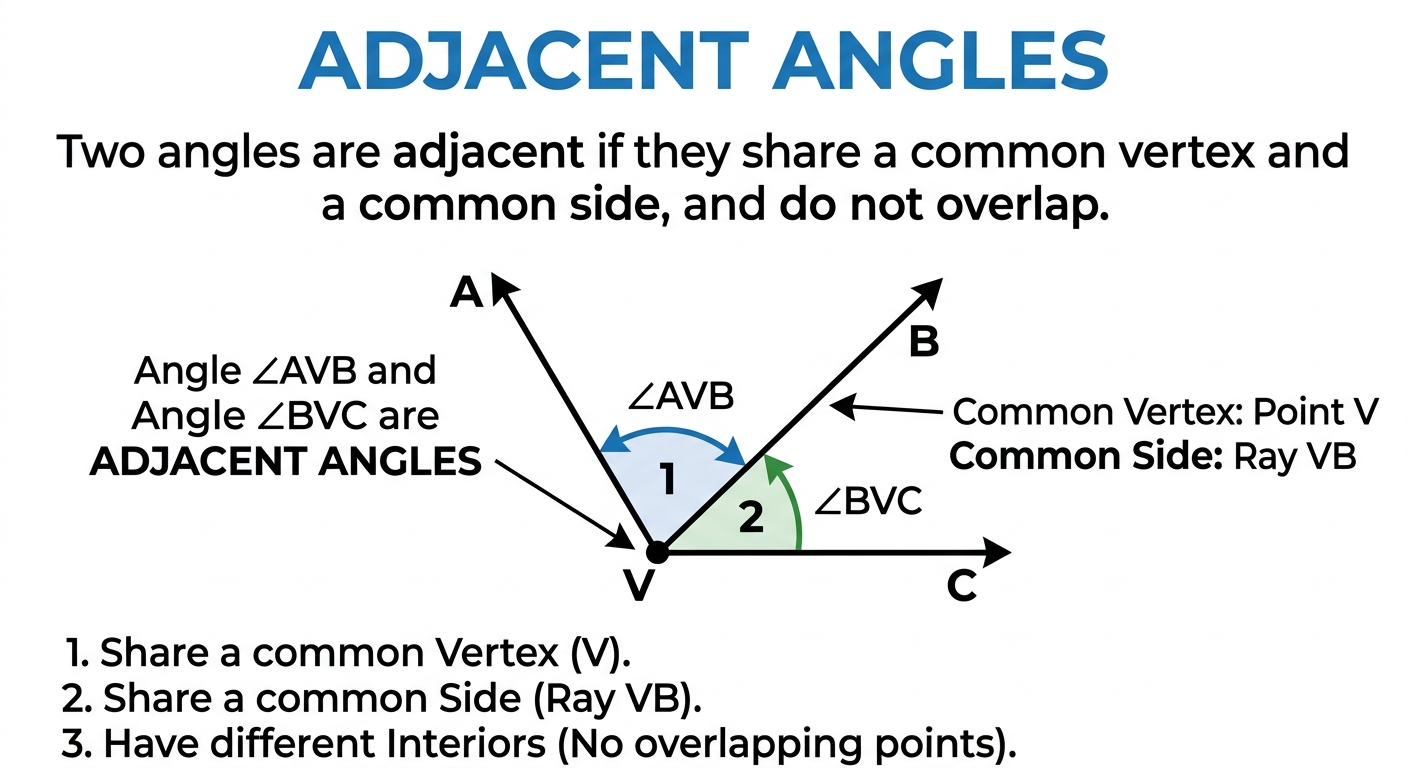
Adjacent Angles: What They Are And How To Spot Them
The short version
- Adjacent angles are two angles that share a vertex and a side and don’t overlap. Picture one angle sitting right next to the other, like two slices of the same pie.
- All three conditions have to be true. Two angles that only touch at the corner point (like vertical angles) are not adjacent.
- Adjacent angles add together. If you know the big angle and one piece, subtract to get the other piece: 70° – 25° = 45°.
- Adjacent doesn’t tell you the sum. Adjacent angles on a straight line add to 180°, adjacent angles in a right-angle corner add to 90°, and otherwise they can add to anything.
Adjacent angles are two angles that share a common vertex and a common side, with no overlap between them. In math, “adjacent” just means “next to,” so adjacent angles sit side by side with one ray acting as a shared wall between them.
Kids lose points on this because they check one condition and skip the others. Below: how to test any pair, how to find a missing angle, and the equation problems that show up in 7th grade.
What does adjacent mean in math?
Outside of geometry class, adjacent means “next to” or “bordering.” Two adjacent houses share a wall. Math uses the word the same way, in a few different places:
- Adjacent angles share a vertex and a side.
- Adjacent sides of a polygon share an endpoint. In a rectangle, a length and a width are adjacent sides; the two lengths are opposite sides.
- The adjacent side in trigonometry is the leg of a right triangle that touches the angle you’re working with (and isn’t the hypotenuse).
- Adjacent vertices of a shape are corners joined by one side.
Most of this post is about angles. The trig meaning gets a short section further down.
The three tests for adjacent angles
To decide if two angles are adjacent, ask three questions. If any answer is no, they aren’t adjacent.
| Test | What to look for |
|---|---|
| 1. Same vertex? | Both angles open from the same corner point. |
| 2. Shared side? | One ray is a side of both angles. |
| 3. No overlap? | The insides of the angles don’t cover any of the same space. The shared ray sits between them. |
Here’s a picture to hold in your head. Point B is a vertex with three rays coming out of it: BA, BD, and BC, with BD in the middle. Angle ABD and angle DBC share vertex B and share ray BD, and BD separates them. They pass all three tests, so they’re adjacent.
Now compare angle ABD with angle ABC. They share vertex B and ray BA. But angle ABC is the big angle that contains angle ABD inside it, so the two overlap. They fail test 3 and are not adjacent. This is the trick question teachers love.
A note on naming angles
Angles are named with three letters, and the vertex always goes in the middle. Angle ABD has its vertex at B. A quick way to check test 1: if two angle names have the same middle letter, they share a vertex. To check test 2, look for a letter the two names share besides the middle one. Angle ABD and angle DBC both include D, so ray BD is the shared side.
How to find a missing adjacent angle
Because adjacent angles don’t overlap, their measures add. Angle measure is additive: the two small angles together make the big one. That gives you one rule for almost every problem:
small angle + small angle = big angle
Example 1: a split angle
Angle ABC measures 70°. Ray BD splits it into angle ABD = 25° and angle DBC. Find angle DBC.
25° + angle DBC = 70°
angle DBC = 70° – 25°
angle DBC = 45°
Check: 25 + 45 = 70. Good.
Example 2: adjacent angles on a straight line
When two adjacent angles have outer sides that form a straight line, they’re called a linear pair, and they add to 180°. If one angle in a linear pair is 118°, the other is:
180° – 118° = 62°
Two angles that add to 180° are supplementary. We cover that relationship in detail in Supplementary Angles, Explained.
Example 3: adjacent angles in a corner
A ray splits a right angle into two adjacent angles. One is 34°. The two angles fill the 90° corner, so they’re complementary:
90° – 34° = 56°
Example 4: the 7th grade equation version
Two adjacent angles form a right angle. One measures (2x + 10)° and the other measures (3x – 5)°. Find x and both angles.
(2x + 10) + (3x – 5) = 90
5x + 5 = 90
5x = 85
x = 17
Now plug x back in:
2(17) + 10 = 44°
3(17) – 5 = 46°
Check: 44 + 46 = 90. Kids often stop at x = 17, but the question asked for the angles too. Always reread the question after you solve.
Adjacent angles vs. other angle pairs
Adjacent describes where angles sit. Complementary and supplementary describe what they add up to. Those are different kinds of labels, and one pair of angles can wear two of them at once.
| Angle pair | Share a vertex? | Share a side? | Sum | Always adjacent? |
|---|---|---|---|---|
| Adjacent angles | Yes | Yes | Anything | Yes, by definition |
| Linear pair | Yes | Yes | 180° | Yes |
| Complementary angles | Sometimes | Sometimes | 90° | No |
| Supplementary angles | Sometimes | Sometimes | 180° | No |
| Vertical angles | Yes | No | Equal to each other | Never |
Vertical angles are the ones that trip kids up. When two lines cross, the angles directly across from each other share a vertex but no side. They’re equal, and they’re never adjacent. Each angle is adjacent to the two angles beside it, though, and those adjacent pairs are linear pairs that add to 180°.
Adjacent angles and adjacent sides in trigonometry
Older students run into “adjacent” again in trig. In a right triangle, pick one of the acute angles. The three sides then get names relative to that angle:
- Hypotenuse: the longest side, across from the right angle.
- Opposite: the side across from your angle.
- Adjacent: the leg that touches your angle.
Take a right triangle with legs 3 and 4 and hypotenuse 5. For the angle across from the side of length 3, the adjacent side is 4. So cosine, which is adjacent ÷ hypotenuse, equals 4/5 = 0.8. Switch to the other acute angle and the labels swap: now 3 is adjacent and 4 is opposite. The word still means “the side next to the angle,” which is why the angle you pick matters.
Common mistakes with adjacent angles
- Calling any two touching angles adjacent. Sharing a corner point isn’t enough. Vertical angles touch at the vertex and still fail the shared-side test.
- Missing the overlap. A small angle and the big angle that contains it share a vertex and a side, so they look adjacent. They overlap, so they aren’t.
- Assuming adjacent means 180°. Only a linear pair adds to 180°. Two adjacent angles could add to 90°, 130°, or any other amount. Look at the diagram for a straight line or a right-angle box before you assume a sum.
- Reading the wrong letter as the vertex. In angle PQR, the vertex is Q. A kid who treats P as the vertex will pick the wrong angles every time.
- Stopping at x. In equation problems, finding x is usually halfway. The question often wants the angle measures.
- Subtraction slips. 180 – 47 is 133, not 143. Most wrong answers on these problems are arithmetic, not geometry.
Practice problems
- Two adjacent angles form a right angle. One measures 27°. What does the other measure?
- Two angles form a linear pair. One measures 131°. What does the other measure?
- Angle PQS and angle SQR are adjacent, and together they form angle PQR = 150°. If angle PQS = 88°, find angle SQR.
- Two lines cross. Are the vertical angles formed adjacent? Explain in one sentence.
- Two adjacent angles form a right angle, and one is twice the size of the other. Find both angles.
- Three adjacent angles fill the whole space around a point. Two of them are 100° and 145°. Find the third.
- Two adjacent angles form a straight line. They measure (4x + 12)° and (2x + 30)°. Find x and both angles.
Answers
- 90 – 27 = 63°
- 180 – 131 = 49°
- 150 – 88 = 62°
- No. They share a vertex but no side, so they fail the shared-side test.
- x + 2x = 90, so 3x = 90 and x = 30. The angles are 30° and 60°.
- A full turn is 360°. 360 – 100 – 145 = 115°
- 6x + 42 = 180, so 6x = 138 and x = 23. The angles are 4(23) + 12 = 104° and 2(23) + 30 = 76°. Check: 104 + 76 = 180.
If your child is stuck on adjacent angles
Adjacent angles show up in 4th grade as the idea that angle measures add, then come back in 7th grade inside equations. When a kid struggles here, the geometry vocabulary is rarely the real problem. It’s usually one of these older skills:
- Reading a protractor or estimating angle size, which is 4th grade work.
- Subtracting from 90, 180, and 360 without errors.
- Solving a two-step equation like 5x + 5 = 90.
If the first two are shaky, check the 4th grade expectations in Math Skills By Grade Level: What Your Child Should Know. If the equation step is where it falls apart, that’s an algebra readiness issue, and it usually traces back further than you’d think. We explain that chain in Struggling With Algebra? The Real Problem Is Usually Fourth Grade Fractions. For a wider view of whether your child is on track, see Is My Child Behind In Math? 12 Signs By Grade Level.
Frequently asked questions
What are adjacent angles in simple words?
They’re two angles right next to each other. They open from the same corner, they share one side, and neither one covers any part of the other.
Do adjacent angles add up to 180 degrees?
Only when their outer sides form a straight line. That special case is called a linear pair. In general, adjacent angles can add up to any amount less than 360°.
Can adjacent angles be complementary?
Yes. If a ray splits a right angle into two pieces, those pieces are adjacent and complementary, because they add to 90°. Complementary angles don’t have to be adjacent, though. Two separate angles of 40° and 50° are complementary even if they’re on opposite sides of the page.
Are vertical angles adjacent?
No. Vertical angles share only a vertex. They have no common side, so they can’t be adjacent.
What grade learns adjacent angles?
Most kids meet the idea in 4th grade, when they learn that angle measures can be added. The term “adjacent angles” and the equation problems usually come in 7th grade.
Find the actual gap
A wrong answer on an adjacent angles problem can come from the vocabulary, the subtraction, or the algebra, and a worksheet grade doesn’t say which. Math Anon starts with a short adaptive assessment that pinpoints the specific skills your child is missing and gives you a written report on what it found.
From there, your child gets about 20 minutes of targeted practice a day on those exact skills, and you get a progress report every week. The assessment is $49, and that full amount is credited back on your first month. Start the assessment or see pricing.





