
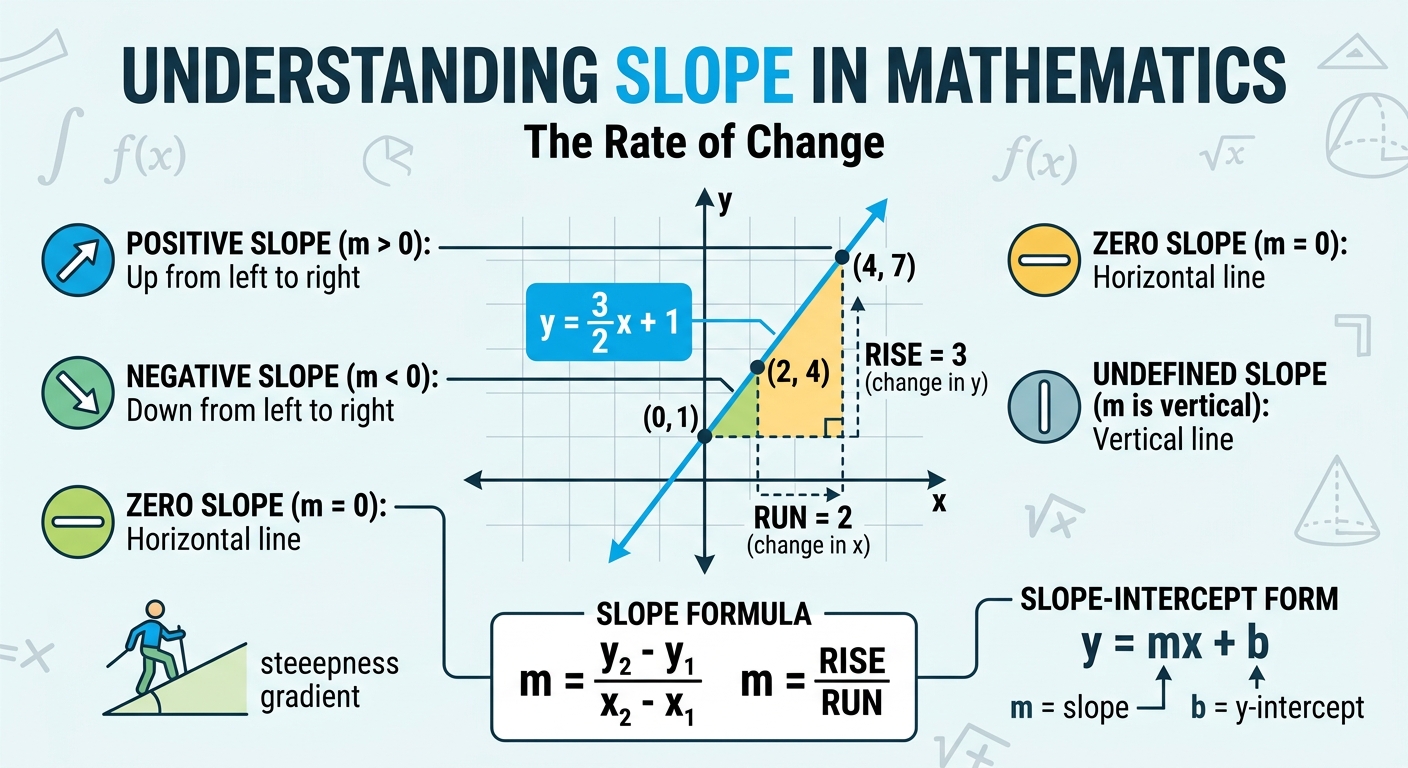
How To Find Slope From Two Points, A Graph, A Table Or An Equation
The short version
- Slope is rise over run: how much a line goes up or down for every one step to the right.
- From two points, use m = (y2 – y1) ÷ (x2 – x1). Subtract the y-values on top and the x-values on the bottom, in the same order.
- From an equation in the form y = mx + b, the slope is the number in front of x. No math needed.
- A horizontal line has a slope of 0. A vertical line has an undefined slope, because you’d be dividing by zero.
Here’s how to find slope: pick two points on the line, find the change in y, find the change in x, and divide the first by the second. The formula is m = (y2 – y1) ÷ (x2 – x1), and the answer tells you how steep the line is and which way it tilts.
The same idea works for a graph, two points, a table or an equation. Below we cover all four.
What slope actually measures
Slope is a rate. It says how much y changes each time x goes up by 1. A slope of 3 means the line climbs 3 units for every 1 unit it moves right. A slope of -1/2 means it drops 1 unit for every 2 units right.
Teachers usually call the vertical change the rise and the horizontal change the run, so slope = rise ÷ run. The letter used for slope is almost always m.
Every straight line falls into one of four types. Reading left to right:
| Type of slope | What the line does | Example |
|---|---|---|
| Positive | Goes up as you move right | m = 2 |
| Negative | Goes down as you move right | m = -3/4 |
| Zero | Flat, perfectly horizontal | y = 5 |
| Undefined | Straight up and down, vertical | x = -2 |
The bigger the number (ignoring the sign), the steeper the line. A slope of -5 is just as steep as 5, tilted the other way.
How to find slope from two points
This is the version most homework asks for. You’re given two points, like (2, 3) and (6, 11), and you need the slope of the line through them.
The steps
- Label the points. Call the first one (x1, y1) and the second one (x2, y2).
- Subtract the y-values: y2 – y1. That’s the rise.
- Subtract the x-values in the same order: x2 – x1. That’s the run.
- Divide rise by run and simplify the fraction.
Example 1: two positive points
Find the slope through (2, 3) and (6, 11).
Rise: 11 – 3 = 8
Run: 6 – 2 = 4
Slope: 8 ÷ 4 = 2
The line goes up 2 for every 1 step right. Positive slope, so it climbs.
Example 2: negative numbers in the mix
Find the slope through (-1, 4) and (3, -2).
Rise: -2 – 4 = -6
Run: 3 – (-1) = 3 + 1 = 4
Slope: -6 ÷ 4 = -3/2
Notice the run step. Subtracting a negative turns into adding, so 3 – (-1) is 4, not 2. This is where a lot of answers go wrong.
Does it matter which point you call “first”? No. If you flip them here you get (4 – (-2)) ÷ (-1 – 3) = 6 ÷ -4 = -3/2. Same answer. What matters is that you use the same order on top and bottom.
How to find slope from a graph
When the line is drawn on a grid, you can count instead of using the formula.
- Find two points where the line crosses the grid exactly at a corner. Guessing at points between grid lines leads to wrong answers.
- Start at the left point. Count how many units up (positive) or down (negative) you go to reach the height of the second point. That’s the rise.
- Count how many units right you go to reach the second point. That’s the run.
- Write rise over run and simplify.
Say a line passes through (0, 1) and (3, 3). From (0, 1), you go up 2 and right 3 to land on (3, 3). The slope is 2/3.
A quick sanity check: if the line goes uphill from left to right, your answer should be positive. Downhill means negative. If the sign doesn’t match the picture, recount.
How to find slope from a table
A table of x and y values is really a list of points, so the same formula works. Pick any two rows.
| x | 0 | 2 | 4 | 6 |
|---|---|---|---|---|
| y | 5 | 11 | 17 | 23 |
Use the first two columns: (0, 5) and (2, 11).
Rise: 11 – 5 = 6
Run: 2 – 0 = 2
Slope: 6 ÷ 2 = 3
Check with two other columns, like (4, 17) and (6, 23): 6 ÷ 2 = 3 again. If the slope changes from one pair of rows to another, the table isn’t a straight line, and there’s no single slope.
A common trap: when x goes up by 2 each row, kids often just report how much y changes (6) and forget to divide by the change in x. Slope is change in y per one unit of x.
How to find slope from an equation
Slope-intercept form: y = mx + b
If the equation is already solved for y, the slope is the coefficient of x. In y = -4x + 7, the slope is -4. In y = x – 2, the slope is 1, because x means 1x. In y = 5, there’s no x term at all, so the slope is 0.
Standard form: Ax + By = C
Solve for y first. Take 3x + 2y = 12.
Subtract 3x from both sides: 2y = -3x + 12
Divide everything by 2: y = -3/2 x + 6
Slope: -3/2
There’s a shortcut once your child understands why it works: for Ax + By = C, the slope is -A ÷ B. Here that’s -3 ÷ 2 = -3/2. Teach the long way first, so the shortcut isn’t just a rule to forget.
Vertical lines
An equation like x = -2 is a vertical line. Any two points on it have the same x-value, so the run is 0. You can’t divide by zero, so the slope is undefined.
Common mistakes when finding slope
- Flipping the fraction. Slope is y-change over x-change. Putting x on top gives the reciprocal, so a slope of 2 turns into 1/2.
- Mixing the order. Doing y2 – y1 on top but x1 – x2 on the bottom flips the sign. With (2, 3) and (6, 11), that gives 8 ÷ -4 = -2 instead of 2.
- Negative number slips. 3 – (-1) is 4. -2 – 4 is -6. Most wrong slope answers come from integer subtraction, not from the slope idea.
- Mixing up zero and undefined. Horizontal is 0. Vertical is undefined. A trick: a horizontal floor is easy to walk on (zero effort); a vertical wall is impossible to walk up (undefined).
- Not simplifying. 6/4 should become 3/2. Many teachers mark 6/4 as incomplete.
Practice problems
- Find the slope through (1, 2) and (4, 8).
- Find the slope through (0, 5) and (2, 1).
- Find the slope through (-3, -1) and (3, 2).
- Find the slope through (-2, 7) and (6, 7).
- Find the slope through (4, 6) and (4, -3).
- A table has x-values 1, 3, 5, 7 and y-values 10, 7, 4, 1. What’s the slope?
- What’s the slope of y = 5x – 9?
- What’s the slope of 4x – 2y = 10?
Answers
- (8 – 2) ÷ (4 – 1) = 6 ÷ 3 = 2
- (1 – 5) ÷ (2 – 0) = -4 ÷ 2 = -2
- (2 – (-1)) ÷ (3 – (-3)) = 3 ÷ 6 = 1/2
- (7 – 7) ÷ (6 – (-2)) = 0 ÷ 8 = 0 (horizontal line)
- (-3 – 6) ÷ (4 – 4) = -9 ÷ 0, so the slope is undefined (vertical line)
- Using (1, 10) and (3, 7): (7 – 10) ÷ (3 – 1) = -3/2
- 5, the coefficient of x
- -2y = -4x + 10, so y = 2x – 5. Slope is 2.
If your child is stuck on slope
When a kid can’t find slope, the slope idea itself is rarely the problem. The formula is short. What trips them up is usually one of the skills it leans on, and those were taught years earlier.
The biggest one is subtracting negative numbers. If 3 – (-1) comes out as 2, every slope with a negative coordinate will be wrong, even when your child sets up the formula perfectly. The next is fractions: simplifying 6/4, dividing -6 by 4, and knowing that -3/2 and 3/-2 are the same number. We wrote about why fraction gaps from fourth grade show up again in algebra in Struggling With Algebra? The Real Problem Is Usually Fourth Grade Fractions. A third is plotting and reading points on the coordinate plane.
A quick test: five integer subtraction problems with negatives and two fractions to simplify. If those go badly, more slope drills won’t help. If you’re not sure whether this is a one-off or a pattern, Is My Child Behind In Math? 12 Signs By Grade Level gives you a checklist, and our guide to math assessment for kids explains how to pin down the exact missing skill.
Frequently asked questions
What is the slope formula?
The slope formula is m = (y2 – y1) ÷ (x2 – x1). It takes any two points on a line and divides the change in y by the change in x.
Is slope rise over run or run over rise?
Rise over run. The vertical change goes on top and the horizontal change goes on the bottom. A way to remember it: you have to rise out of bed before you can run.
How do you find slope with two points?
Subtract the y-values, subtract the x-values in the same order, and divide. For (1, 4) and (5, 12), that’s (12 – 4) ÷ (5 – 1) = 8 ÷ 4 = 2.
What does a slope of 0 mean?
The line is flat. The y-value never changes no matter how far you move along x, so the equation looks like y = 4. That’s different from an undefined slope, which belongs to a vertical line.
How do you find the slope of a line in standard form?
Solve the equation for y so it looks like y = mx + b, then read off m. For Ax + By = C, the slope works out to -A ÷ B.
Find the actual gap
If slope keeps going wrong, it’s worth finding out which earlier skill is behind it before you spend another evening on it. Math Anon starts with a short adaptive assessment that checks the skills slope depends on, like integer operations, fractions and the coordinate plane, and gives you a written report on exactly what’s missing.
From there your child gets about 20 minutes a day of practice aimed at those gaps, and you get a progress report every week. The assessment is $49, and that’s credited back in full on the first month if you continue. Start the assessment or see pricing.
Related reading
- Struggling With Algebra? The Real Problem Is Usually Fourth Grade Fractions
- Is My Child Behind In Math? 12 Signs By Grade Level
- Mind The Gap: A Parent’s Guide To Math Assessment For Kids
- Why 20 Minutes A Day Beats A 90-Minute Tutoring Session
- What Is Point Slope Form? Formula, Examples And Practice
- Quadratic Function: Definition, Graph, Vertex And Zeros





