
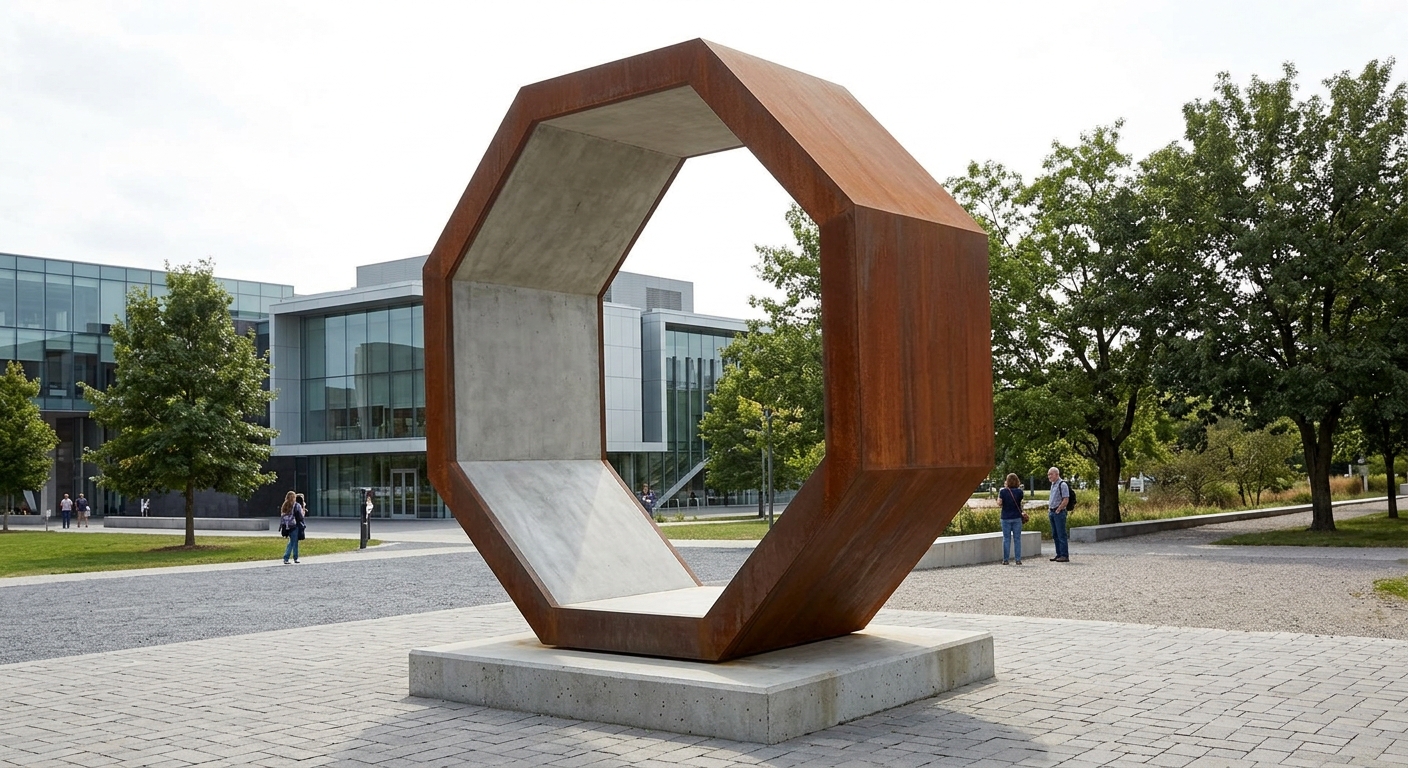
Octagon: How Many Sides, Angles And Area
The short version
- An octagon is a flat shape with 8 straight sides, 8 corners and 8 angles. Any 8 sided shape is an octagon, whether or not the sides are equal.
- The interior angles of every octagon add up to 1,080°. In a regular octagon, each angle is 1,080 ÷ 8 = 135°.
- The perimeter of a regular octagon is 8 × the side length.
- The area of a regular octagon is about 4.83 × side². With a side of 5 cm, that’s roughly 120.7 cm².
- A stop sign is the best known regular octagon.
An octagon is a polygon with 8 sides and 8 angles. The name comes from the Greek okto, meaning eight, and gonia, meaning angle. So if you’re wondering how many sides an octagon has, the answer is always 8. What changes from one octagon to another is whether those sides and angles are equal.
Below we cover the types of octagons, how to find the angles, perimeter and area with worked examples, how octagons compare with other polygons, and the mistakes kids make. Practice problems with answers are near the end.
Octagon properties at a glance
| Property | Any octagon | Regular octagon |
|---|---|---|
| Sides | 8 | 8, all equal |
| Vertices (corners) | 8 | 8 |
| Sum of interior angles | 1,080° | 1,080° |
| Each interior angle | Varies | 135° |
| Each exterior angle | Varies (they still total 360°) | 45° |
| Diagonals | 20 | 20 |
| Lines of symmetry | Depends on the shape | 8 |
Types of octagons
Regular octagon. All 8 sides are the same length and all 8 angles are 135°. A stop sign is the classic example.
Irregular octagon. The sides or angles aren’t all equal. It still has 8 sides, and its angles still add to 1,080°.
Convex octagon. Every interior angle is less than 180°, so all the corners point outward. Every regular octagon is convex.
Concave octagon. At least one interior angle is more than 180°, which makes a corner that caves inward. A block capital T is a good example: trace its outline and you’ll count 8 sides, with two corners bending in where the stem meets the top bar.
Interior angles of an octagon
Any polygon can be split into triangles by drawing lines from one corner to all the others. An octagon splits into 6 triangles, and each triangle holds 180°:
(8 – 2) × 180° = 6 × 180° = 1,080°
That’s the sum of the interior angles of an octagon, and it’s true for every octagon, regular or not. The general rule is (n – 2) × 180°, where n is the number of sides.
For a regular octagon, split that total evenly:
1,080° ÷ 8 = 135° per angle
Exterior angles
An exterior angle sits outside the shape, between one side and the extension of the next side. Each interior angle and its exterior angle form a straight line, so they’re supplementary and add to 180°. For a regular octagon:
180° – 135° = 45°
Check: 8 × 45° = 360°, and the exterior angles of any convex polygon total 360°.
If supplementary angles are fuzzy, our post on supplementary angles covers them.
Finding a missing angle
An irregular octagon has seven angles that add up to 945°. What’s the eighth?
1,080 – 945 = 135°
Perimeter of an octagon
Perimeter is the distance around the outside. For a regular octagon, all sides match:
Perimeter = 8 × side
A regular octagon with 7 inch sides has a perimeter of 8 × 7 = 56 inches.
Working backward: a regular octagon has a perimeter of 72 cm. Each side is 72 ÷ 8 = 9 cm.
For an irregular octagon, add all 8 sides. With sides 3, 4, 3, 4, 3, 4, 3 and 4 m, the perimeter is 4 × 3 + 4 × 4 = 12 + 16 = 28 m.
Area of an octagon
For a regular octagon with side length s:
Area = 2(1 + √2) × s², which is about 4.828 × s²
Example: A regular octagon has sides of 5 cm.
s² = 5 × 5 = 25
Area ≈ 4.828 × 25 ≈ 120.7 cm²
Where the formula comes from
Picture a square with its four corners cut off at 45°. What’s left is a regular octagon. Each cut removes a small right triangle. If you find the big square’s area and subtract the four corner triangles, you land on 2(1 + √2) × s². Older students can check this themselves; it’s a good exercise in the Pythagorean theorem.
Using the apothem
Some textbooks give the apothem, the distance from the center to the middle of a side. Then:
Area = ½ × perimeter × apothem
A regular octagon with 10 cm sides has an apothem of about 12.07 cm. The perimeter is 8 × 10 = 80 cm.
Area ≈ ½ × 80 × 12.07 = 40 × 12.07 ≈ 482.8 cm²
Check with the other formula: 4.828 × 10² = 482.8 cm². They agree.
Irregular octagons
There’s no single formula. Break the shape into rectangles and triangles, find each area, and add them up. Many worksheet octagons are drawn on grid paper so you can count squares and half squares.
How the octagon compares to other polygons
| Sides | Name | Sum of interior angles | Each angle if regular |
|---|---|---|---|
| 5 | Pentagon | 540° | 108° |
| 6 | Hexagon | 720° | 120° |
| 7 | Heptagon | 900° | about 128.6° |
| 8 | Octagon | 1,080° | 135° |
| 9 | Nonagon | 1,260° | 140° |
| 10 | Decagon | 1,440° | 144° |
Notice the hexagon’s total is 720°. Kids sometimes mix that up with the octagon’s 1,080°. Each extra side adds another 180°.
Why octagon floor tiles need squares
Regular octagons can’t cover a floor on their own. Around any corner point the angles must total 360°, and two octagons give 135 + 135 = 270°, leaving a 90° gap. A square fills it exactly: 135 + 135 + 90 = 360°. That’s why you often see octagon tiles with small square tiles between them.
Common mistakes with octagons
- Using 720° as the angle sum. That’s a hexagon. An octagon’s angles total 1,080°.
- Dividing by 8 on an irregular octagon. Each angle is 135° only when the octagon is regular.
- Confusing octagon and hexagon. Hexagon has 6 sides. The “oct” in octagon matches octopus, which has 8 arms.
- Forgetting the square on s². Area uses side × side. With s = 5, that’s 25, not 10.
- Calling any shape with 8 corners regular. Equal looking isn’t equal. Check the side lengths.
Practice problems
1. How many sides and how many vertices does an octagon have?
2. A regular octagon has 6 cm sides. What’s its perimeter?
3. A regular octagon has a perimeter of 96 inches. How long is each side?
4. What is the sum of the interior angles of an octagon?
5. An irregular octagon has seven angles that add up to 960°. What’s the eighth angle?
6. What is each exterior angle of a regular octagon?
7. How many diagonals does an octagon have? (Hint: from each corner, you can draw a diagonal to every corner except itself and its two neighbors.)
8. Find the area of a regular octagon with 4 cm sides, to the nearest tenth.
Answers
1. 8 sides and 8 vertices.
2. 48 cm (8 × 6)
3. 12 inches (96 ÷ 8)
4. 1,080°
5. 120°, since 1,080 – 960 = 120.
6. 45°. Either 180 – 135 = 45 or 360 ÷ 8 = 45.
7. 20. Each of the 8 corners connects to 8 – 3 = 5 others, giving 8 × 5 = 40, but that counts each diagonal twice, so 40 ÷ 2 = 20.
8. About 77.3 cm². s² = 16, and 2(1 + √2) × 16 ≈ 77.25, which rounds to 77.3.
What it means if your child is stuck on octagons
Counting sides is easy. The octagon questions that go wrong are the angle and area ones, and the reasons are usually older skills. The angle sum needs a kid to multiply 6 × 180 and divide 1,080 by 8 comfortably. The missing angle problems are subtraction. The area formula needs squaring and a decimal multiplication. If any of those is shaky, the geometry falls apart even when the idea makes sense.
Check whether the mistakes are geometry mistakes or arithmetic ones. Our grade level skills guide shows what should already be solid, and these signs by grade help you spot a pattern across topics. When you can’t tell where the problem starts, a math assessment is the quickest way to find out.
Frequently asked questions
What is an 8 sided shape called?
An octagon. Any flat shape with 8 straight sides is an octagon, even if the sides are different lengths.
How many sides does an octagon have?
8 sides, along with 8 vertices and 8 interior angles.
What is the sum of the interior angles of an octagon?
1,080°. It comes from (8 – 2) × 180° = 1,080°, and it holds for every octagon.
What is each angle of a regular octagon?
135°. Divide the total by 8: 1,080 ÷ 8 = 135.
Is a stop sign a regular octagon?
Yes. In the United States, stop signs are regular octagons with equal sides and equal angles.
What’s a 3D octagon called?
A solid with two octagon faces joined by rectangles is an octagonal prism. A solid with an octagon base and triangles meeting at a point is an octagonal pyramid.
Find the actual gap
If octagon homework keeps going sideways, it’s worth knowing whether the trouble is the geometry or the arithmetic underneath it. Math Anon’s short adaptive assessment answers that, pinpointing the exact skills that are missing and laying them out in a written report.
From there, your child practices those skills for roughly 20 minutes a day, and you get a weekly progress report. The assessment costs $49 and is credited back in full on the first month. Start the assessment or look at pricing.





